
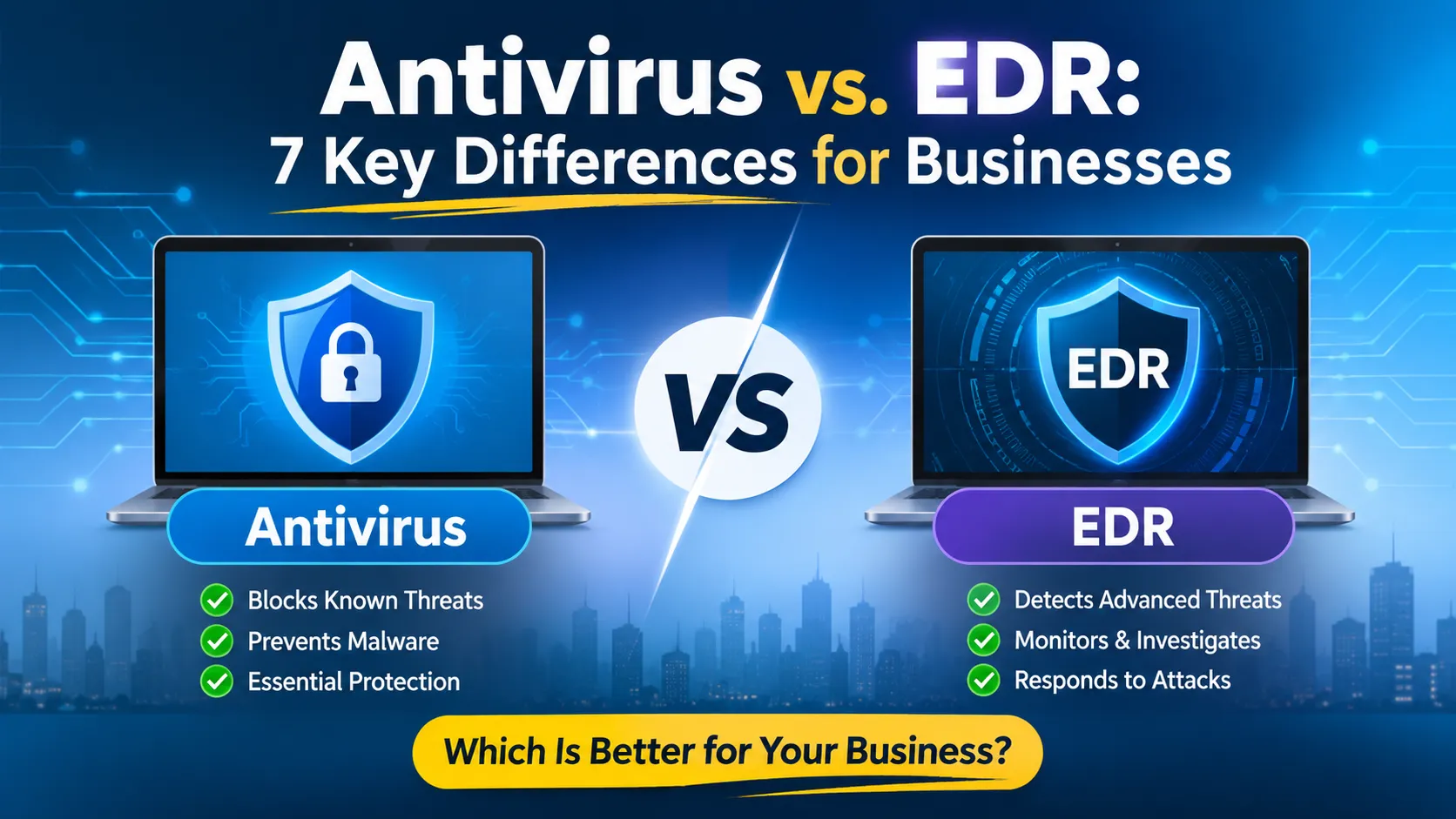
Antivirus vs. EDR: Key Differences & Which Is Better for Your Business?
Cyber threats are becoming harder to detect, and traditional security tools may not be enough to protect your business. Antivirus software and Endpoint Detection and Response (EDR) both help protect computers and devices, but they work in different ways.
Understanding EDR vs antivirus can help you choose the right protection for your business. While antivirus focuses mainly on blocking known threats, EDR offers deeper monitoring and helps security teams investigate and respond to suspicious activity.
What Is Traditional Antivirus Software?
Traditional antivirus software protects computers by scanning files, programs, and downloads for malware. It compares suspicious files against known threat signatures and uses other detection methods to identify harmful activity.
When it finds a threat, it can block, quarantine, or remove the infected file.
For example, if an employee downloads a file containing known malware, antivirus software may detect it before it causes damage.
However, traditional antivirus software may struggle with new or advanced threats that don't match known patterns. Modern antivirus products have improved with behavioural analysis and cloud-based detection, but their capabilities vary.
What Is Endpoint Detection and Response?
What is endpoint detection and response? EDR is a security technology that continuously monitors endpoint devices, such as laptops, desktops, and servers, for suspicious activity.
Instead of simply scanning for malware, EDR collects activity data and looks for unusual behaviour that could indicate an attack.
For example, if a device suddenly starts accessing sensitive files or running suspicious commands, an EDR tool can flag the activity. Depending on its features and configuration, it may isolate the device, stop a process, or help security teams investigate what happened.
This makes EDR useful for identifying threats that traditional antivirus tools might miss.
EDR vs Antivirus: Key Differences
Both tools support endpoint security, but their approach and capabilities are different.
Feature | Traditional Antivirus | EDR |
Main purpose | Detect and block malware | Detect, investigate, and respond to threats |
Detection | Signatures and other detection methods | Behavioral monitoring and threat analysis |
Monitoring | Often focused on file and malware scans | Continuous endpoint activity monitoring |
Threat investigation | Usually limited | Detailed activity records and investigation tools |
Response | Block, quarantine, or remove threats | May isolate devices and stop suspicious processes |
Best suited for | Basic device protection | More advanced threat detection and response |
The main difference in antivirus vs EDR is that antivirus primarily prevents and removes malware, while EDR provides broader visibility into endpoint activity and helps manage threats after suspicious behaviour appears.
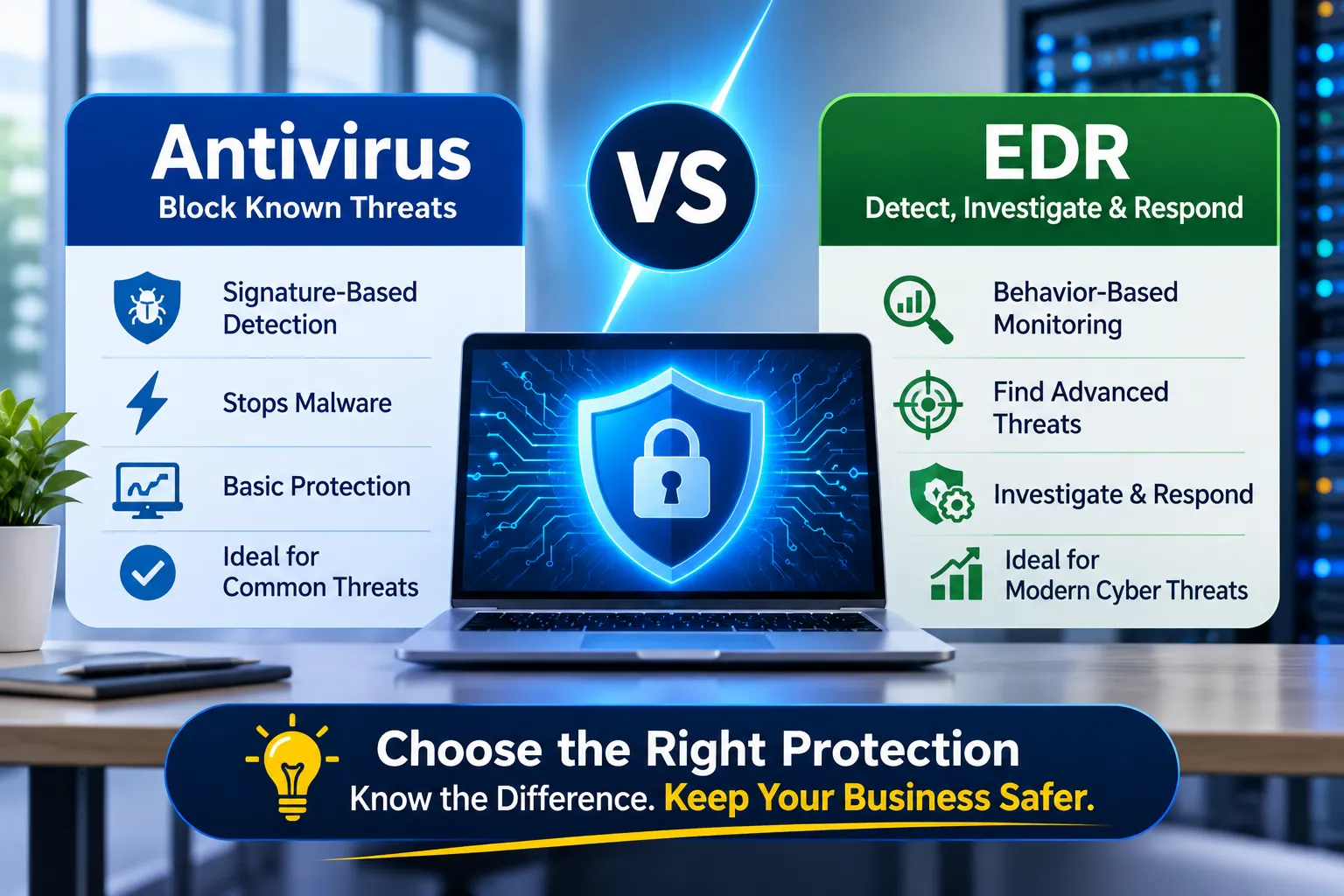
EDR vs Traditional Antivirus: Which Offers Better Protection?
Traditional antivirus remains useful for everyday protection. It can stop many common threats, including known viruses, malicious downloads, and infected files.
However, businesses face more than simple malware infections. Attackers may use stolen login details, malicious scripts, or legitimate system tools to access company networks.
EDR can help detect these activities by monitoring behaviour rather than relying only on known malware signatures.
This doesn't mean EDR prevents every attack. Its effectiveness depends on the product, configuration, monitoring, and how quickly alerts are handled.
Benefits of Endpoint Security Solutions for Businesses
Choosing the right endpoint security solutions helps businesses protect the devices employees use to access company systems and data.
Here are some important benefits:
Threat detection: Identify suspicious activity before it spreads across the network.
Device protection: Secure laptops, desktops, and other supported endpoints.
Faster response: Help security teams investigate and contain potential attacks.
Better visibility: Understand what is happening across business devices.
Reduced downtime: Responding quickly can limit disruption and recovery costs.
For companies handling customer information, financial records, or confidential business data, endpoint security should be an important part of the overall cybersecurity plan.
Is EDR Protection Worth It for Small Businesses?
Many small businesses assume EDR is only necessary for large companies. However, smaller organizations can also face ransomware, phishing, and account-based attacks.
EDR protection for small businesses can be valuable when employees work remotely, use multiple devices, or access sensitive information.
If your business doesn't have an in-house security team, consider working with a managed security provider that can monitor alerts and help respond to suspicious activity.
For businesses with limited budgets and simpler IT needs, modern antivirus or endpoint protection software may be a reasonable starting point. The right choice depends on your risk level, available resources, and security requirements.
Can Antivirus and EDR Work Together?
Yes. Antivirus and EDR can complement each other.
Antivirus helps block common malware, while EDR adds deeper monitoring, investigation, and response capabilities. Some modern endpoint security products combine both functions in one platform.
Using both approaches can provide stronger endpoint protection for businesses, especially when supported by regular updates, employee awareness training, access controls, and reliable backups.
Conclusion:
Choosing between antivirus and EDR depends on the level of protection your business needs. Traditional antivirus can handle many common threats, while EDR provides deeper monitoring and more advanced response capabilities.
For businesses with higher security risks or sensitive information, EDR may be a worthwhile investment. Whatever you choose, keep your systems updated, train employees to recognize threats, and make sure your security tools are monitored regularly.
Frequently Asked Questions
Is EDR better than antivirus?
EDR generally offers more advanced threat detection, monitoring, and response capabilities. However, antivirus is still useful for blocking common malware. The best option depends on your business needs and security risks.
Does EDR replace antivirus software?
Not always. Many EDR platforms include antivirus capabilities or work alongside antivirus tools. Check the product's features before assuming you have both types of protection.
Can EDR detect ransomware?
EDR can identify suspicious behaviour associated with ransomware, such as unusual file changes or processes. Some products can also help contain the threat, but no security tool guarantees complete protection.
Is EDR necessary for small businesses?
It can be helpful, especially for businesses that handle sensitive data, support remote employees, or rely heavily on digital systems. Managed EDR can make advanced protection easier to maintain.
What is the difference between EDR and endpoint protection?
Endpoint protection is a broad term for tools that secure devices. EDR is a specific type of endpoint security technology focused on detecting, investigating, and responding to threats.