
Cybersecurity Risk Assessment: A Practical Guide for Businesses
A cybersecurity risk assessment for businesses can feel like a huge, overwhelming task. It sounds technical, expensive, and a bit scary. The reality is far more practical. It is a structured process designed to answer two core questions: What are your most critical assets? And what could go wrong with them?
What is a Cyber Risk Assessment?
A cyber risk assessment is a systematic process of identifying, evaluating, and managing potential threats to your business. It is not just about your technology. It looks at your IT risk assessment, your people, your processes, and even your suppliers.
The goal is to take a hard look at your business cybersecurity assessment, pinpoint the systems that are essential to keeping things running, and figure out what security gaps could be exploited. Think of it as a health check for your digital security.
Why Risk Assessments Matter in 2026
If you have not assessed your cyber risks, you have no idea if your existing security controls are effective. Here is why a security risk assessment is so important:
To Prevent Costly Breaches: The average cost of a data breach in 2025 was $4.44 million, according to IBM. Many breaches exploit vulnerabilities that organizations had already identified but never addressed. A proper assessment forces you to confront these risks before they become costly incidents.
To Justify Security Spending: By translating abstract threats into tangible financial figures, an information security risk assessment provides a clear business case for your security budget. It shows leadership exactly which investments will reduce the highest-priority risks.
To Meet Compliance: Regulations like HIPAA, GDPR, and PCI DSS require organizations to document their risk posture and show evidence of ongoing assessments. Businesses often rely on IT compliance services to help meet these regulatory requirements. A structured assessment produces the audit trails needed to satisfy regulators.
A Step-by-Step Guide to the Process
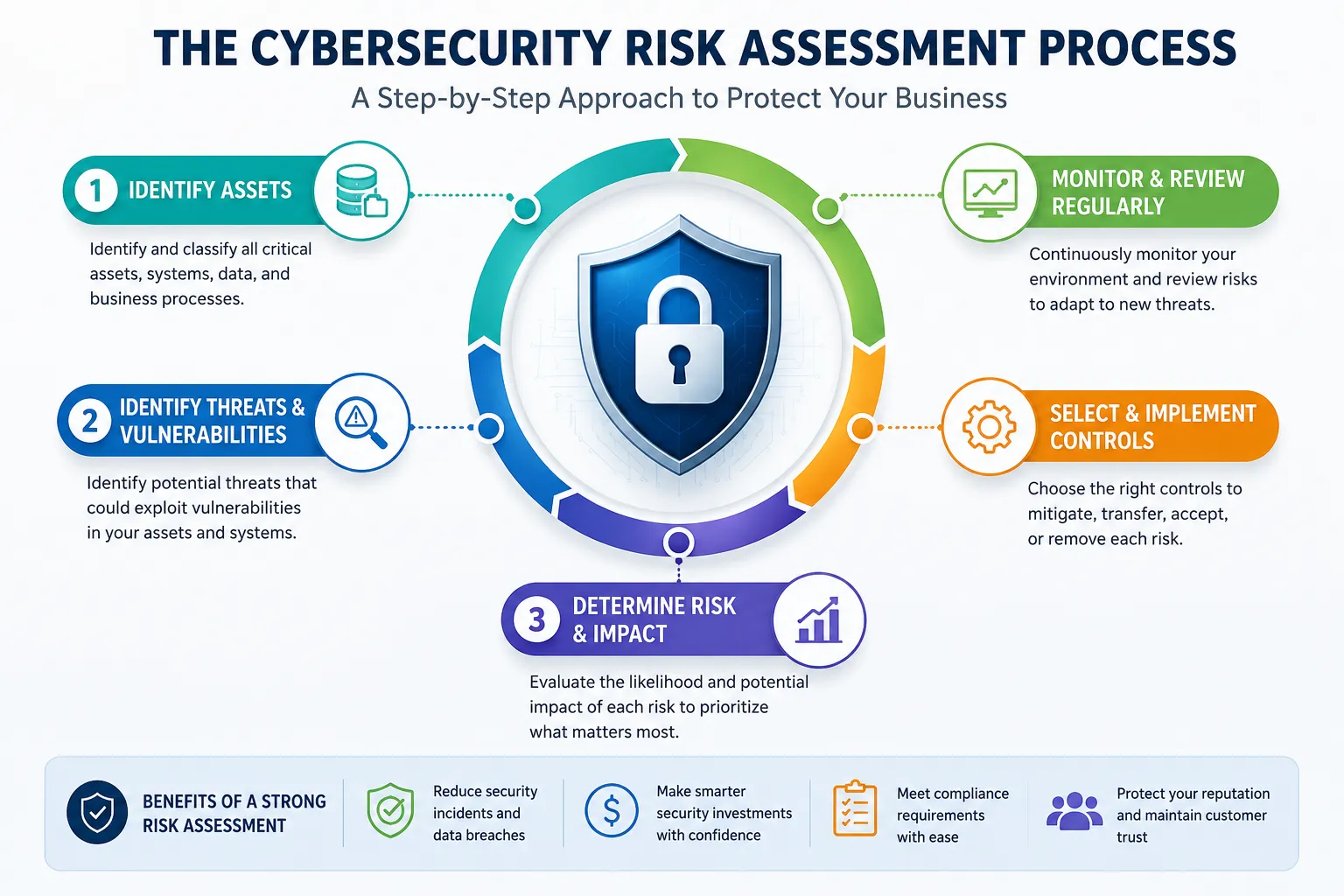
While every organization is different, a standard cybersecurity risk assessment for businesses process generally follows these steps:
1. Identify and Classify Your Assets
Start with a complete inventory of what you need to protect. This includes hardware, software, data, and even intellectual property. Focus on the business processes that are most important to you and the systems that store your data.
Internal Systems: Those you host and manage yourself.
External Systems: Those you access through a web browser (like Office 365) .
2. Identify Threats and Vulnerabilities
Identify threats: What could cause harm? This can be anything from a cybercriminal launching a ransomware attack to an employee accidentally deleting a file.
Identify vulnerabilities: What are the weaknesses that allow threats to cause damage? Common issues include outdated software, weak passwords, misconfigured firewalls, or a lack of staff training.
3. Determine Risk and Impact
A risk is the potential that a threat will exploit a vulnerability and cause financial harm .
Analyze the potential impact: What would happen if a specific risk became reality? Consider financial loss, operational downtime, legal liability, reputational damage, and data loss.
Score the risk: Organizations typically score risks as High, Moderate, or Low based on their likelihood and potential impact. This helps you prioritize.
4. Select and Implement Controls
Implement strategies to manage your risks. Managed IT services can help businesses deploy and maintain these security controls as part of a long-term cybersecurity strategy.
Mitigate: Implement technical measures like firewalls, MFA, and encryption.
Transfer: Use cyber insurance to offset financial risk.
Accept: Acknowledge the risk and do nothing if the cost of fixing it exceeds the potential loss.
Remove: Shut down the system or stop collecting the data.
Cybersecurity Risk Assessment Checklist
The whole thing gets way easier when you break it down step by step. Here's a solid cybersecurity risk assessment checklist to follow.
Establish a cyber risk management plan: Get leadership on board. Define what level of risk is okay and get them to sign off on your strategy.
Audit your assets and infrastructure: Run vulnerability scans to find missing patches and weak spots in your setup.
Analyze your threats and vulnerabilities: Use automated tools and human judgment together. One catches things, the other makes sense of them.
Assess risk levels across process chains: Map threats to your key business processes. Understand what a breach would actually do to your operations.
Define controls and an incident response plan: Spell out who does what when an attack hits. A solid plan means faster recovery and less financial damage.
Monitor and review: Cybersecurity never stops. New threats show up every day. Reassess at least once a year — and anytime something big changes in your IT environment.
Conclusion
A cybersecurity risk assessment for businesses is not something you do once and forget about. It's the foundation of a security strategy that actually adapts. When you take a systematic look at what you got and what threats are out there, you can make smarter calls, spend your money where it counts, and build resilience that keeps your business safe, no matter what comes.
Frequently Asked Questions
What is a cybersecurity risk assessment for businesses and why do I need one?
It's a process that figures out what could go wrong with your data and systems and ranks what's most dangerous. You need one to know where you're weak, avoid costly breaches, and show the big bosses where to spend money.
How often should I conduct a cybersecurity risk assessment for businesses?
Do a full one at least once a year. Also run one after big changes like moving to the cloud, after a breach, or when new rules come out. Keep a constant eye on your most valuable stuff.
What's the difference between a risk assessment and a vulnerability scan?
A vulnerability scan is just a tool that spots known weaknesses in your software and networks. A risk assessment is way bigger, it looks at threats, weak spots, what your assets are worth, and what would actually hurt your business. Then it builds a game plan.
What are the key components of a cybersecurity risk assessment?
You need a full list of everything you own. Identify threats and weak spots. Score each risk by how bad it could hit your business. Then put together a clear plan to fix or improve your security.
How do I prioritize risks from a cybersecurity risk assessment for businesses?
Rank them by business impact. Use a matrix to figure out how likely and how bad each one is. Tackle the "High" risks first, the ones that could really mess you up financially or operationally. Keep a log showing who owns each risk and what's being done about it.