
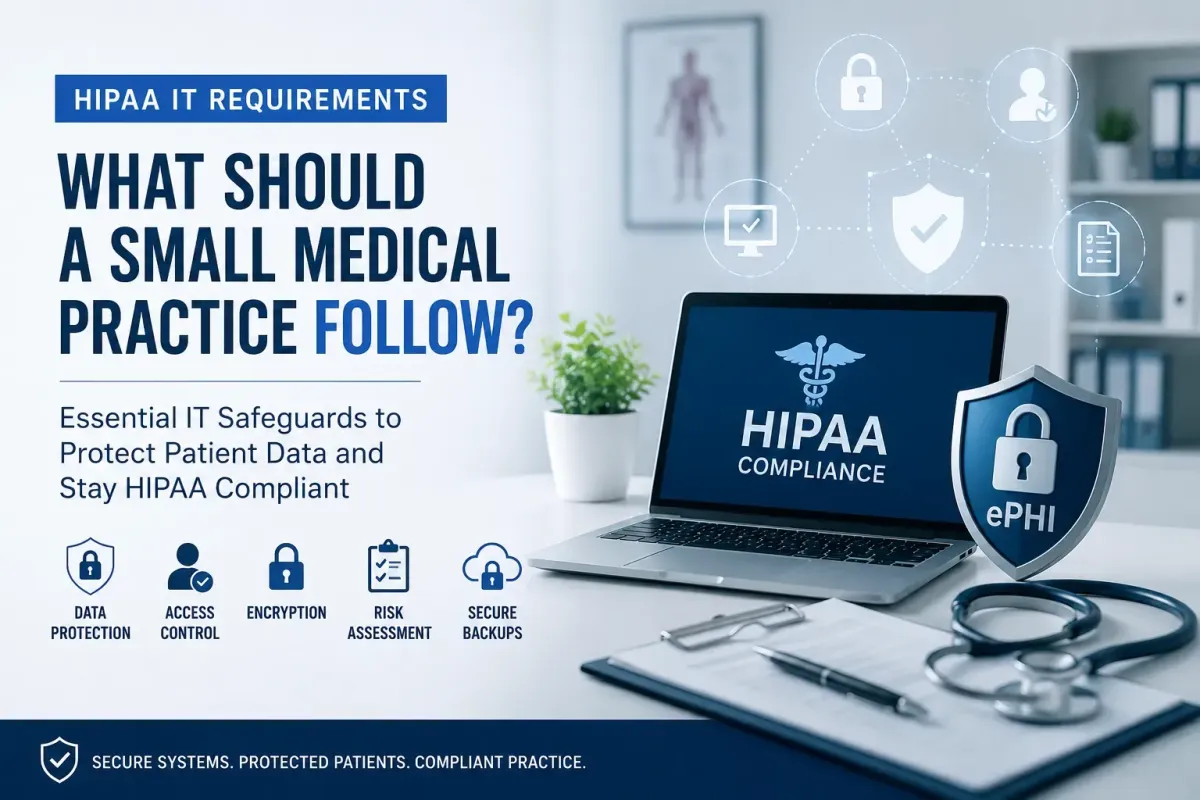
HIPAA IT Requirements: 8 Key Safeguards for Small Practices
There is no universal technology checklist for practices under HIPAA. Rather, it calls for covered entities to implement reasonable safeguards in light of their risks and situation. For small medical practices, the amount of sensitive information handled daily makes IT security of utmost importance.
Knowing the HIPAA IT requirements for a practice can help keep the EPHI safe and ensure continued compliance.
What Are HIPAA IT Requirements for Small Medical Practices?
The HIPAA requirements for small medical practices are designed to safeguard the electronic protected health information from unauthorized access, alteration, loss, or disclosure.
A practice should evaluate the risks of its systems, devices, networks, and data and take reasonable precautions to protect them.
Key areas include:
Access management
User authentication
Data protection
Risk assessments
Security policies
Employee training
Secure backups
Incident response
Compliance with HIPAA does not mean that you just have to buy some security software. It also includes policies, procedures, staff duties and ongoing risk management.
What HIPAA Security Requirements Should a Small Practice Follow?
HIPAA security requirements include administrative, physical, and technical security.
For IT systems, techniques should regulate access to patient data, and only allow access for those with job responsibilities. Risks can be mitigated through strong authentication, secure devices, regular monitoring and suitable security policies.
Staff should also be aware of the signs of phishing, keep their passwords secure, deal with patient data and report any security concerns.
What Are HIPAA Technical Safeguards?
HIPAA technical safeguards are the technology-based controls that help ensure the security and privacy of electronic patient information.
They can include:
User access controls
Unique user identification
Authentication
Audit controls
Data integrity protections
Secure transmission
Encryption when appropriate
The steps help to safeguard information that can only be accessed by authorized users and that electronic data is not accessible to or subject to unauthorized changes by unauthorized users.

What are the HIPAA Cybersecurity Requirements for Medical Practices?
HIPAA cybersecurity requirements include the protection of systems from threats like malware, phishing, unauthorized access and data loss.
For a small practice, it may be enough to implement some practical measures like firewalls, anti-malware software, multi-factor authentication, security updates, secure backups, and employee awareness programs.
Important areas include:
Keeping up to date operating systems and applications
Using strong authentication
Protecting email accounts
Maintaining secure backups
Monitoring suspicious activity
Education of staff about security risks
How Should Small Practices Protect Patient Data?
Protecting electronic patient information throughout its life cycle is the key to following HIPAA data security requirements.
Data should be safeguarded during storage, retrieval, transfer and backup. Practices should also be aware of where patient data is stored and who has access to it.
Only accessible to those authorized workers who require the information for their work.
How Can a Small Medical Practice Maintain HIPAA IT Compliance?
Maintaining HIPAA IT compliance requires ongoing attention rather than a one-time setup.
A practical approach includes:
Conduct a security risk assessment.
Identify vulnerabilities and potential threats.
Limit access to sensitive information.
Use appropriate encryption and authentication.
Maintain secure backups.
Monitor systems and user access.
Train employees regularly.
Update software and security controls.
Document policies and procedures.
Review and update the security program regularly.
The goal is to identify reasonable and appropriate safeguards based on the practice's specific risks. For practices that need additional support implementing and maintaining these safeguards, IT compliance services can help address ongoing security and compliance needs.
What Are Common HIPAA IT Mistakes Small Practices Make?
Even with the best intentions, small practices may not pay attention to basic security concerns. The issues are strong passwords, too many privileges, out-of-date software, insecure devices, poor employee education and training, and missing backups.
If risk assessments and security measures are not recorded and security protocols not adhered to, this can also be problematic for demonstrating that adequate measures are being taken.
How Can a Small Practice Improve HIPAA Compliance?
The first step is to analyse the existing IT landscape and locate where patient data is currently being stored, accessed and moved. A risk assessment can be used to prioritize weaknesses, instead of attempting to do everything at once.
The HIPAA IT requirements are a continual security duty. Over time, regular reviews, employee training, access management, software updates and policies can help to improve protection.
Conclusion
Complying with HIPAA IT requirements isn't just about installing cybersecurity software. Small practices require a realistic security program that includes access, authentication, data protection, risk management, employee training, backups, and constant monitoring.
The appropriate safeguards vary based on the size of the practice, systems, risks and circumstances. Assessment and improvement efforts can help safeguard patient information and contribute to achieving HIPAA compliance for small medical practices on a regular basis. Professional HIPAA Compliance Services can also help practices assess their environment and maintain appropriate safeguards over time.
Frequently Asked Questions
What are the basic HIPAA IT requirements for small medical practices?
Essential elements include securing electronic protected health information with administrative, physical, and technical safeguards, risk assessment, access control, security policies, and training of employees.
Does a small medical practice need encryption?
HIPAA doesn't mandate that all data types be encrypted in all cases. Where appropriate, practices need to consider the use of encryption as an important security measure, depending on the risks they face.
What are HIPAA technical safeguards?
Technical safeguards of HIPAA contain access controls, authentication, audit controls, integrity protection and security during transmission of electronic patient information.
Does HIPAA require cybersecurity software?
HIPAA does not specify the type of cybersecurity product and technology. Practices should put in place reasonable and appropriate safeguards in relation to their risk assessment, including firewalls, malware protection, monitoring and other measures.
How often should a medical practice conduct a HIPAA risk assessment?
A practice should carry out a risk assessment as part of its regular security management activities and review risks when there are significant changes to systems, technology, operations and/or threat.
What are HIPAA network security requirements?
Electronic patient information should not be accessible to unauthorized users or be subjected to threats to the network. These can involve firewalls, secure configurations, access control, monitoring, updates and network protections.
How should small practices protect patient data?
Small practices need to determine where patient information is kept and shared, only allow access to authorized individuals, secure devices and network, keep proper backups, educate staff, and continually assess the risks.
Does HIPAA require employee cybersecurity training?
The HIPAA Security Rule requires covered entities to implement a security awareness and training program for workforce members. The security practices relevant to the organization's environment should be addressed during training.
What happens if a small medical practice is not HIPAA compliant?
Failure to comply may result in investigations, corrective measures, and civil monetary penalties for a practice. But, security vulnerabilities can also compound the risk of breaches and exposure of patient information.
How can a small medical practice maintain HIPAA IT compliance?
A practice can maintain compliance by regularly assessing risks, reviewing access permissions, updating safeguards, training employees, maintaining documentation, monitoring systems, and addressing identified security weaknesses.