
HIPAA Risk Assessment: Why It Matters & How to Prepare
HIPAA Risk Assessment is basically sitting inside a healthcare system and slowly going through everything that touches patient data and asking one very real, very practical question again and again: where can things go wrong, how can they go wrong, and what actually happens if they do.
HIPAA security risk analysis is more like stepping into a system and observing everything in real time.
HIPAA Risk Assessment
To really understand HIPAA compliance assessment, think of it like this:
It is like walking through a healthcare environment and just thinking in very simple everyday questions:
Where is patient data actually sitting
Who can open it right now
Who should not have access but still does
What happens if a password gets stolen
What happens if a laptop is lost
What happens if a vendor system gets attacked
What happens if someone makes a small mistake
And as these questions keep building, HIPAA assessment checklist slowly creates a full picture of reality.
Not assumptions.
Real conditions.
Why HIPAA Risk Assessment Matters So Much Today
Healthcare systems are no longer simple or isolated.
Everything is connected now.
And because of that, HIPAA Compliance Services becomes extremely important.
Patient records are stored in cloud systems
Staff access systems remotely
Multiple apps are connected together
Vendors are plugged into internal workflows
Data is moving constantly between platforms
So risk is not sitting in one place anymore.
It is moving too.
And HIPAA security solutions is what keeps track of that movement.
Without it, everything looks fine until something suddenly breaks.
HIPAA Risk Assessment is Not a One-Time Activity
One of the most important things to understand is this:
Risk Assessment is not something that is done once and forgotten.
It keeps repeating.
Because nothing stays the same in real systems:
New tools get added
Old systems get updated
Staff roles change
Access permissions shift
Vendors are added or removed
Workflows evolve constantly
And every small change quietly changes the risk level.
So HIPAA Risk Management keeps coming back again and again like a regular check on system safety.
Not because of paperwork.
But because reality keeps changing.
How HIPAA Risk Assessment Actually Works in Practice
When it is done properly, it feels like a slow, careful walkthrough of everything.
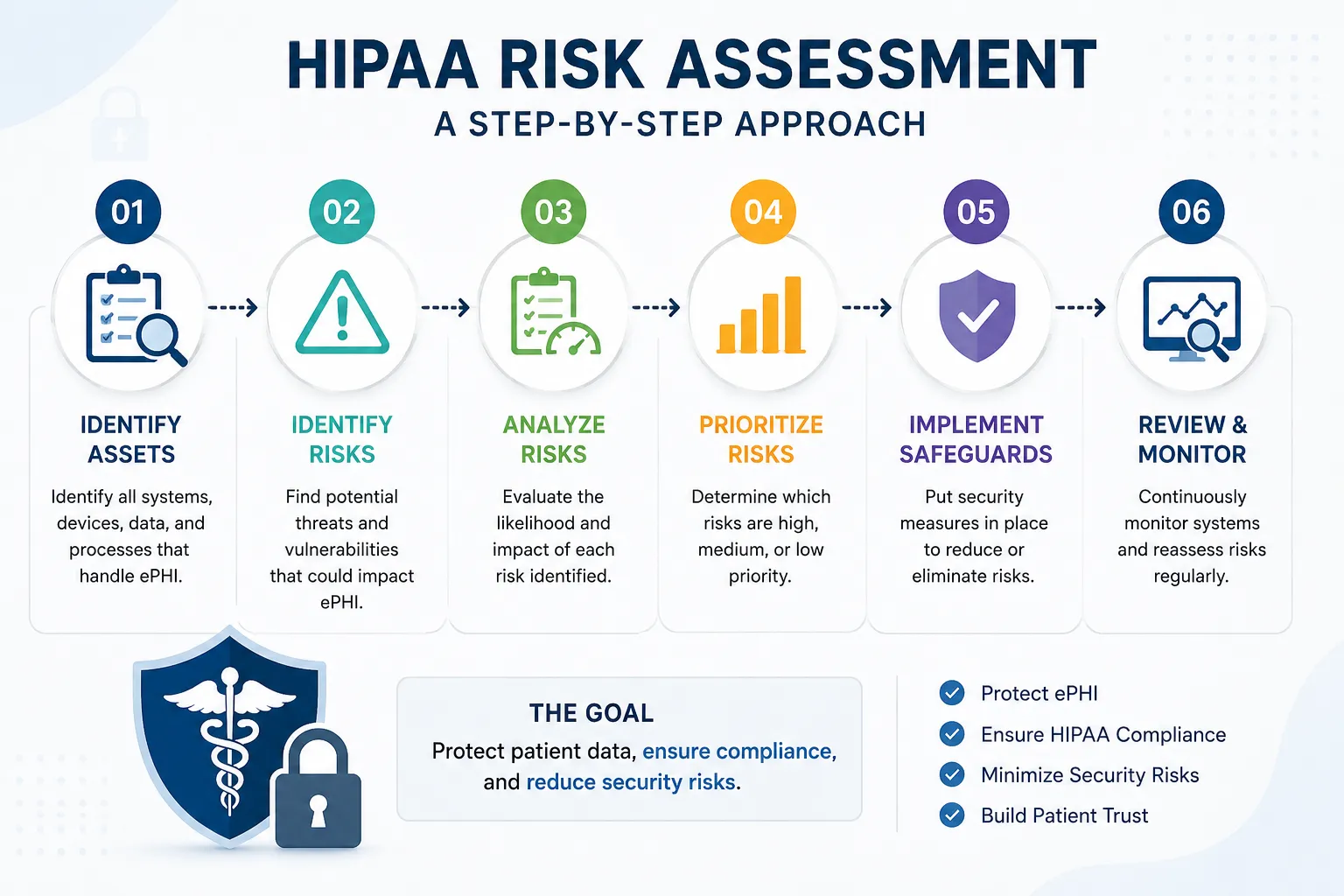
First, everything is identified:
systems, apps, databases, cloud tools, devices, and vendor connections.
Everything that touches patient data is brought into view.
Then it goes deeper.
It starts asking real-life questions like:
What if someone gets access who should not
What if a login is stolen and used silently
What if data is sent to the wrong place
What if a system fails at the worst time
What if a vendor gets hacked and spreads risk inside
This is the point where Risk Assessment becomes very real.
Because now it is no longer theory.
It is scenario-based thinking.
Then everything gets sorted:
What is small risk, what is serious risk, what needs urgent attention.
And finally, it turns into action:
Fixing weak points, tightening access, improving systems, and reducing exposure.
HIPAA Assessment is About Visibility
A simple way to understand Risk Assessment is this:
It shows what is normally hidden in day-to-day operations.
Because in normal use:
Systems look fine
Everything feels functional
Nothing seems broken
But underneath that normal flow, there can still be:
Weak access control, outdated software, missing protections, and unnoticed risks.
So Risk Assessment brings all of that into visibility.
Where most HIPAA Risk Assessment Problems Come From
Most issues are not extreme or complex.
They usually come from very normal things like:
Systems left outdated
Users having more access than needed
Vendors added without proper review
Backups not tested properly
Security settings never reviewed
Risk assessments not repeated regularly
And slowly, these small gaps turn into bigger risks that show up during HIPAA Risk.
HIPAA Risk Assessment in Simple Thinking Flow
Even though it sounds technical, HIPAA Risk usually comes down to simple questions:
Where is data stored
Who can access it
How is it protected
How does it move
Who is connected to it
What happens if something fails
How quickly can it be fixed
That is the full foundation of Risk Assessment.
What Happens After Risk Assessment
Once Risk Assessment is completed, everything shifts from observation to action.
Now there is clarity about:
Where risks exist, how serious they are, and what must be fixed first.
So action begins:
Closing security gaps
Restricting unnecessary access
Improving encryption
Updating systems
Training staff
Setting up monitoring
And after some time, Risk Assessment is done again because systems continue to change.
Conclusion:
At the core, Risk Assessment is not just about compliance.
It is about awareness.
Awareness of:
Where patient data exists
How it moves
Who can access it
Where it can be exposed
What can go wrong
And turning that awareness into action before problems happen. That is the real purpose of HIPAA risk.
Frequently Asked Questions
What is HIPAA risk assessment?
It is the process of slowly checking every system and workflow that handles patient data and understanding where it can be exposed or misused before any real damage happens.
Why is HIPAA risk assessment important today?
It is important because healthcare systems are fully connected and constantly changing, which means risks can appear anytime without being noticed if they are not checked regularly.
Is HIPAA risk a one-time task?
No, HIPAA risk is ongoing because systems, users, vendors, and tools keep changing, and every change can introduce new risks that must be reviewed.
What does risk assessment actually cover?
Risk assessment covers systems, data storage, access control, vendors, workflows, devices, and everything that interacts with patient information.
What is the main goal of HIPAA Risk?
The main goal of risk assessment is to find risks early, understand their impact, and reduce them before they turn into real security or compliance problems.
Does HIPAA assessment only involve technical systems?
No, HIPAA assessment also includes human behaviour, internal processes, staff access, and third-party vendors, not just technical systems.
What happens if HIPAA assessment is not done?
If HIPAA assessment is not done, organizations can face data breaches, compliance violations, financial penalties, and loss of patient trust.
Who performs HIPAA assessment?
HIPAA assessment is usually done by internal compliance teams, IT security teams, or external HIPAA security consultants.
What is checked during HIPAA risk assessment?
HIPAA risk assessment checks where data is stored, who can access it, how it moves, and what risks exist across the entire healthcare system.
Why do organizations repeat HIPAA risk assessment?
Organizations repeat HIPAA assessment because systems constantly change, and every change can introduce new risks that need to be reviewed and controlled.