
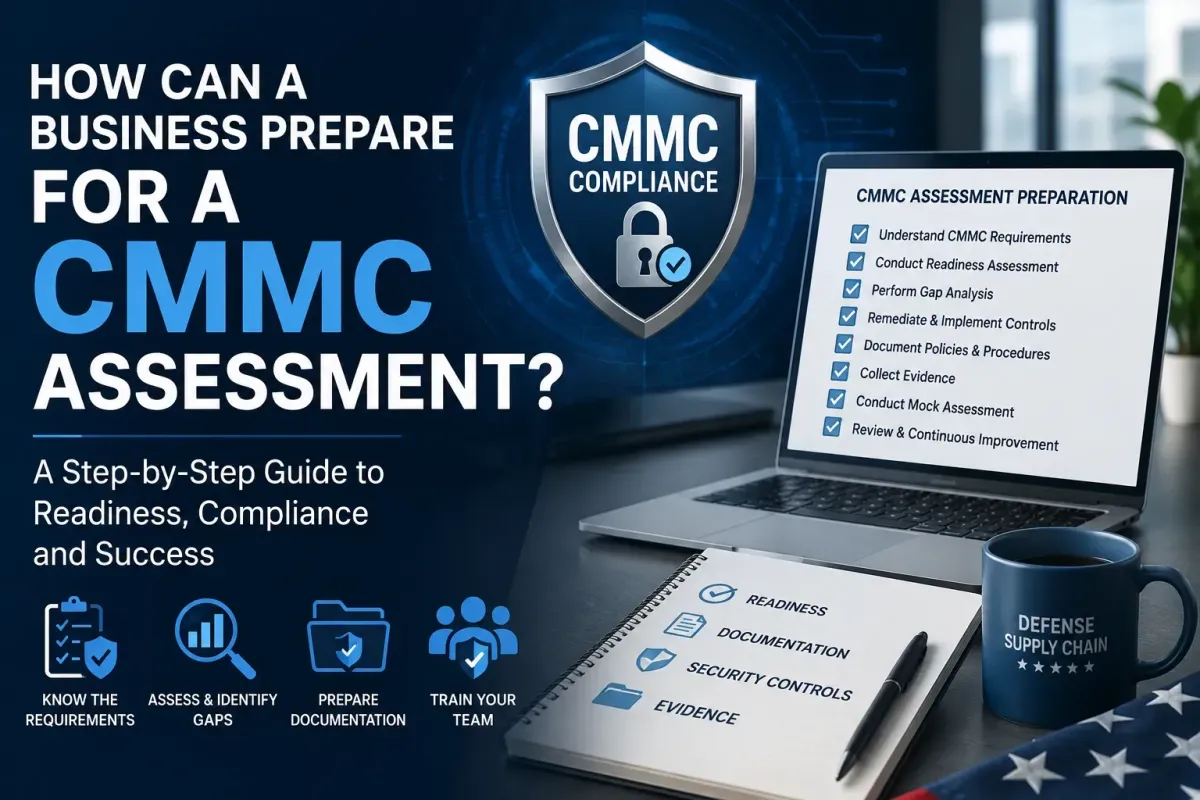
How Can a Business Prepare for a CMMC Assessment?
The process of preparing for a CMMC assessment is more than just a checklist of cybersecurity controls. A business must have an understanding of the information it deals with, be aware of security flaws, record its practices and ensure that employees are doing the necessary procedures correctly at all times.
Preparing can be the difference between a smooth assessment and time and expense delays for organizations that work with the U.S. Department of Defense or that handle Federal Contract Information or Controlled Unclassified Information.
A clear, step-by-step breakdown helps to find gaps, troubleshoot issues, gather evidence, and build confidence prior to the formal assessment.
What is a CMMC Assessment?
A CMMC assessment is a process that determines if an organization meets the cybersecurity practices and processes outlined in its Cybersecurity Maturity Model Certification level.
The assessment does not just focus on whether security tools have been bought. Assessors are looking at whether or not the required security practices are actually in place, documented, maintained and supported with evidence.
A business is thus required to make preparations for its technical and documentation environment.
Why is it Important to Prepare for CMMC Assessment?
Waiting until an assessment date may put unneeded pressure on a student. There can be weeks or months to fix security vulnerabilities, and missing policies or incomplete documentation can add to the issues.
A good CMMC assessment preparation process enables a business:
Identify cybersecurity weaknesses prior to the formal review
Identify the criteria to be considered for the organisation
Ensure policies, procedures and evidence are organised
Identify the security needs and allocate them to the appropriate person.
Address technical and administrative issues properly
Respond to Questions from the Assessor
The first step is to have a CMMC Readiness Assessment. It must be to know where the organization is today.
A CMMC readiness assessment is a comparison of actual company practices to the requirements of the company's CMMC level.
This should review access control, authentication, system monitoring, incident response, configuration management and media protection, and other pertinent security practices.
The goal is not just to check off "required" or "not required. Evidence of implementation of each requirement should be provided to demonstrate how the organization meets the requirement.
Perform a CMMC Gap Assessment
A CMMC gap assessment is used to determine what the difference is between the organization's actual security environment and the requirements that it must meet. A good gap assessment should sort out results in terms of importance and remediation effort.
Identify Critical Gaps
Missing security controls
Weak access management
Inadequate system monitoring
Unprotected sensitive information
The most common response is to have no incident response procedures.
Identify Documentation Gaps
Outdated policies
Incomplete procedures
Missing system documentation
Inconsistent records
Lack of evidence of implementation.
Prioritize Remediation
Not all problems can be resolved at the same time. Identify gaps that have the greatest security risk, CMMC requirements, business impact and effort required to correct gaps.
Identify the places and conditions where CUI occurs. Know where and how CUI occurs.
An important component of preparing is identifying where Controlled Unclassified Information is stored, processed, transmitted and accessed.
Processing of CUI is involved in the following applications:
Cloud services for the storage and processing of information.
Network connections
External service providers
Review Policies and Procedures
The CMMC compliance assessment is not just about technology. Documentation and organizational processes are important too. Businesses may also benefit from IT compliance services when reviewing policies related to the following:
Access control
Incident response
Risk management
Configuration management
The protection of systems and communications.
Personnel security
Physical protection
Security awareness and training
Policies need to be representative of the business's operations. A document that is well written but not reflective of real-world practice can cause issues on assessment.

Collect Assessment Evidence
Evidence may vary from policy, procedure, system configuration, log files, training records, access review, vulnerability report, incident report, or other evidence of implementation as required.
Establish a repository of evidence and associate each requirement with the evidence or technical evidence supporting it. This gives the CMMC assessment process more structure and helps to cut down the time spent looking for records.
Assessors may inquire about the actual practice of security procedures with personnel. Staff members need to be aware of their duties and be familiar with the procedures to be followed by the organisation in relation to activities of a security nature.
Passwords and authentication requirements.
Phishing awareness
Reporting suspicious activity
Handling sensitive information
Incident reporting
Acceptable system use
Physical security requirements
It is important for employees to know the procedures.
Complete a CMMC Security Assessment
Do an internal review of the environment prior to the formal assessment. A security assessment performed as part of a CMMC should determine if security controls are working as intended. Test the controls rather than simply reviewing documentation.
If, for instance, a policy states that access is reviewed regularly, then check that access reviews have been undertaken. If systems are supposed to create security logs, check that logging is turned on and that somebody is looking at pertinent events.
This way, they can find out about vulnerabilities that a paper-based system might not uncover.
Perform a CMMC Mock Assessment
A CMMC mock evaluation can be beneficial to help with practice prior to the formal evaluation. The internal team can do a simulation assessment by asking:
Does the organisation have an understanding of each of the applicable requirements?
Are there clear indications of evidence?
Do policies align with practices?
Are the employees able to describe their security duties?
Are the weaknesses identified documented?
Have corrective actions been carried out?
The aim is to make it as similar as possible to the formal assessment.
Read Your System Security Plan
The System Security Plan documents how the security requirements are met and is an important part of this documentation. Carefully examine the plan to ensure it reflects the organization's context.
Check whether:
Systems are accurately labelled.
Security controls are accurately described
Tasks are clearly defined
The CUI environment is correctly set up
Existing security practices comply with documentation
Changes to the environment have been reflected
An out-of-date plan can lead to confusion as assessors may compare what is documented with what they see in the real environment.
Complete CMMC Audit Preparation
While not a financial-style audit, organizations sometimes use the term "CMMC audit preparation" when referring to their preparation activities.
The goal is still the same: ensure that the organization can provide evidence of security requirements being applied and supported that are applicable.
Make a final preparation checklist for:
Technical controls
Policies
Procedures
Evidence
Employee training
System documentation
Access permissions
Incident response
Vulnerability management
Outstanding remediation items
Use a CMMC Assessment Guide as a Checklist
A CMMC assessment guide can help prepare and make sure key areas are not forgotten. A checklist should not, however, be used as the whole preparation strategy. The organization must be aware of the application of requirements in the specific environment.
The requirements should ultimately address three questions:
What is required?
Be aware of the relevant cybersecurity practice.
How is it put into practice?
Find the technology, process or procedure that meets the requirement.
What proves it?
Find the evidence which proves that the practice is carried out and sustained.
What Should a Business Do 90 Days Before Assessment?
Having a structured timetable helps in preparation.
The timeline may need to be longer for organizations with complex environments or significant remediation requirements. This is a key aspect to preparing for CMMC assessment.
Conclusion:
The assessment for a CMMC should be considered a cybersecurity project, not simply a compliance exercise. For organizations managing multiple remediation tasks, documentation updates, and security improvements, IT project management services can help keep these efforts organized.
Conduct a readiness review, a gap analysis, determine the CUI environment, remediate weaknesses, update documentation, gather evidence, train employees, and do a mock assessment.
The best preparation is to link documentation to security practices. If all of these elements are in alignment, the organization will have a much stronger position to show compliance.
Frequently Asked Questions
How long does it take to get ready for an assessment of a CMMC?
Prep time depends on the size of the organization, CMMC level, existing cyber security controls, CUI environment, documentation and gaps. It can take several months for businesses with major deficiencies.
Which of the following is the initial step in preparing for CMMC assessment?
The first step is to understand the applicable CMMC requirements and assess the current security environment of the organization. A readiness assessment can detect weaknesses prior to remediation efforts.
What is the difference between a CMMC readiness assessment and gap assessment?
A readiness assessment is used to determine overall readiness, whereas a gap assessment is used to determine the gap between current practices and applicable requirements. These can be helpful during preparation.
What documents are needed for a CMMC assessment?
Documentation requirements vary based on the requirements and context, but typically include policies and procedures, system documentation, security records, and evidence of practice.
What is a CMMC Mock Assessment?
Yes. The mock assessment can help to uncover missing evidence, unclear procedures, employee knowledge gaps, and technical weaknesses before the formal assessment. Also, it provides teams a chance to rehearse responding.
Is CMMC solely assessing cybersecurity technology?
CMMC assessing cybersecurity practices and processes. Other policies, procedures, employee duties, documentation and evidence can be significant.
Why is it crucial to identify CUI for CMMC?
The scope of the assessment is determined by identifying the location of CUI storage, processing, transmission, and access. Organizations can easily miss out on relevant systems if they are not aware of the CUI environment.
What is the best way to structure the evidence for CMMC assessments?
Evidence should be presented in a manner that is structured to meet the requirements of the appropriate controls or practices. Preparation can be a lot easier when there's a centralized, well-maintained evidence repository.
Does a business have the capability to conduct its security assessment?
Internal reviews and readiness assessments can be done by an organization to find weaknesses. An internal review, however, does not always equate to the formal assessment that would be needed for certification at the appropriate CMMC level.
What is the worst error companies make prior to a CMMC assessment?
The single most common error is waiting until the assessment is near to be closing the security loopholes. The key is to begin preparation early enough such that it is possible to identify