Dark Web Monitoring for Orlando Businesses - Kevlar IT Solutions
Dark Web Monitoring for Orlando Businesses: How to See Stolen Data Before It Gets Used Against You
On July 28, 2024, staff at OneBlood, the Orlando-based nonprofit that supplies blood to roughly 250 hospitals across the Southeast, noticed something odd on their network. By the next morning they were in full ransomware response mode. For nearly two weeks, employees labeled blood products by hand because the software that normally does it was locked down. Hospitals across four states activated shortage protocols while a Central Florida nonprofit tried to keep blood moving with sticky notes and phone calls. Months later, OneBlood confirmed the attackers had also copied donor files containing names and Social Security numbers, and it began mailing breach notices the following January.
That's not a hypothetical. It happened here, to an organization headquartered a few miles from downtown Orlando, and it's the kind of story that should reframe how local business owners think about cybersecurity.
Most people still picture cyber risk as a hacker breaking through a firewall in real time. That's rarely how it plays out anymore. More often, someone's credentials were stolen months or years ago in a breach that had nothing to do with your company, and those credentials are sitting in a criminal marketplace right now, waiting to be bought and reused. You won't see it happen. You'll just see the aftermath: a wire transfer that goes to the wrong account, a ransom note, a customer calling to ask why their data showed up somewhere it shouldn't.
What Actually Happens When a Company's Data Ends Up on the Dark Web?
Stolen usernames, passwords, session tokens, and customer records get bought and sold every day on criminal forums and dark web marketplaces. A lot of it doesn't come from some dramatic hack of your own systems. It comes from infostealer malware quietly sitting on an employee's laptop, from a vendor's compromised device, or from an old breach at a completely unrelated service that happened to reuse a password.
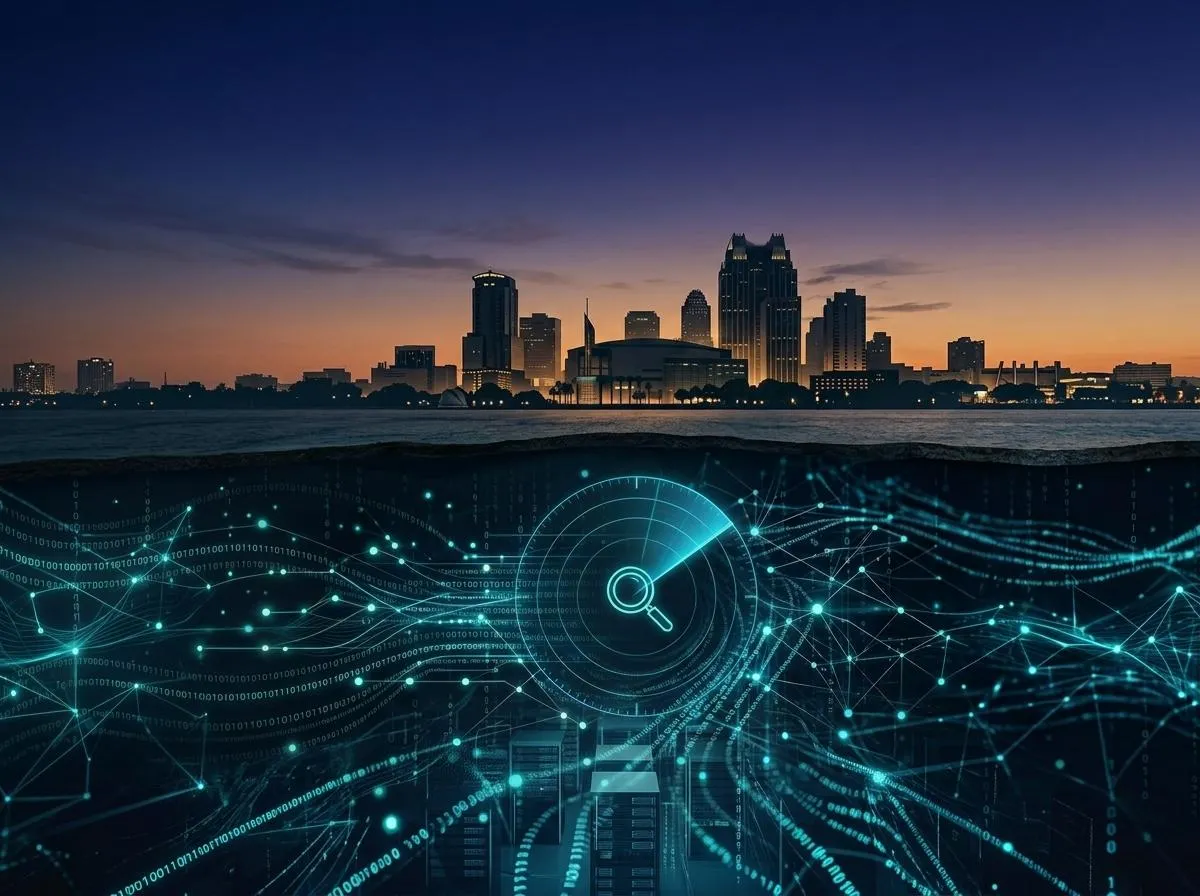
By the time a business finds out its data is circulating, it's usually already been resold and used more than once. Dark web monitoring exists to close that gap. It's a continuous scan of the places where this data shows up, paired with an alert the moment your company's name, domain, or credentials appear. Instead of finding out from a customer or a lawsuit, you find out first.
Why Does Florida Keep Ranking Near the Top for Cybercrime?
It's not a fluke, and it's not new. According to the FBI's Internet Crime Complaint Center (IC3) 2024 Internet Crime Report, Florida ranked third among all states in both the number of complaints filed (52,191) and total dollar losses reported ($1.07 billion), trailing only California and Texas. Florida residents over 60 fared even worse by comparison: they filed 11,902 complaints and lost $388.4 million, again the third-highest total in the country.
Nationally, the IC3 report logged 859,532 complaints and $16.6 billion in losses for 2024, a 33% jump from the year before. Personal data breaches alone accounted for 64,882 of those complaints and $1.45 billion in reported losses. None of that counts the incidents that never get reported, which most researchers believe is the majority of them.
Florida's size explains part of the ranking. But size alone doesn't explain why the state consistently lands in the top three year after year, or why its cybercrime losses per capita ($4,586,256 per 100,000 residents in 2024, per IC3) run well above the national median. A large population of retirees, a tourism economy built on constant credit card transactions, and a dense cluster of small and mid-sized businesses with limited IT staff all play a role.
What Makes Orlando Specifically Worth a Second Look?
Central Florida isn't just theme parks, though the volume of consumer payment data flowing through the region's hospitality and tourism sector is real and constant. Orlando is also home to two of the state's largest health systems, AdventHealth and Orlando Health, and healthcare stays the single most expensive industry for breach recovery. IBM and the Ponemon Institute's 2024 Cost of a Data Breach Report put the average healthcare breach at $9.77 million, more than double the $4.88 million global average across all industries.
Then there's the piece a lot of outsiders don't know about. Orlando is home to Team Orlando, a cluster of Department of Defense commands, contractors, and academic partners built around modeling, simulation, and training technology. The Orlando Economic Partnership describes it as an $11 billion-plus economic driver anchored by a key defense command, and more than 140 companies operate out of the Central Florida Research Park alone, including major defense contractors. That kind of concentration, government contracts, sensitive technology, and a supply chain of smaller vendors and subcontractors, is exactly the profile criminals look for. A compromised credential at a small simulation subcontractor can be a foothold into something much bigger.
Put those three sectors together, tourism and hospitality, healthcare, and defense-adjacent technology, and Orlando has more high-value targets per square mile than its population alone would suggest.
Local incidents back this up. Orlando Family Physicians, a Central Florida practice, notified 447,426 patients in 2021 after an employee responded to a phishing email and handed over their login credentials, exposing medical records, insurance details, and in some cases passport numbers, according to reporting from HIPAA Journal and Becker's Hospital Review. That's not a Fortune 500 company. It's a local physicians' group, and it's still one of the ten largest healthcare breaches reported that year nationwide.
What Does Florida Law Actually Require After a Breach?
Florida has one of the strictest breach notification laws in the country, and it's worth understanding even if your provider handles compliance for you. Under the Florida Information Protection Act (Fla. Stat. § 501.171), a business that experiences a breach of Florida residents' personal information must notify those individuals within 30 days of determining a breach occurred, with a possible 15-day extension for documented good cause. If 500 or more Florida residents are affected, the business must also notify the Florida Attorney General's Office within that same window. Penalties escalate the longer notification is delayed, up to $500,000 per breach, though Florida law doesn't allow individuals to sue directly over a late notice.
Thirty days sounds like a lot of time until you're the one living through it. Most businesses spend the first week or two just figuring out what happened. A monitoring system that flags exposed credentials early gives you a head start on that clock instead of starting it the moment a customer or a ransom note tells you something's wrong. This is general legal context, not advice, and any specific compliance question belongs with an attorney familiar with Florida law.
What's Changed in the Last Year or Two?
The threat landscape most Orlando business owners learned about a few years ago isn't the one they're facing now.
Infostealer malware has become the dominant delivery method. It sits quietly on a device, harvests saved passwords, browser autofill data, and session cookies, then packages everything into a “log” that gets sold in bulk. A single infected laptop, often a personal device an employee also uses for work, can expose dozens of business accounts at once.
Session cookie theft is also bypassing multi-factor authentication in ways a lot of businesses haven't caught up to. MFA protects a login. It does nothing once an attacker already has an active session token stolen from an infected browser. That token can be used to walk straight into an inbox, a CRM, or a banking portal without ever touching a password or an MFA prompt.
Meanwhile, ransomware keeps hitting small and mid-sized businesses disproportionately hard. Verizon's 2025 Data Breach Investigations Report found ransomware present in 88% of breaches at small and mid-sized organizations, compared to just 39% at large enterprises. Attackers aren't necessarily more sophisticated against small businesses. They're just easier to get into, and dark web credential exposure is frequently the way in.
And increasingly, exposed data doesn't just sit there. Generative AI tools make it faster to turn a leaked email address and a few personal details into a convincing phishing message, a cloned voice, or a fake executive on a video call. The dark web used to be the end of the attack chain. Now it's often the starting material.
One-Time Scan or Continuous Monitoring: What's the Real Difference?
A lot of businesses think they've already handled this because someone ran a dark web scan once, maybe during a security assessment two years ago. That's a snapshot, not protection. New exposure can happen any day, and a scan from 2023 tells you nothing about what leaked last month.
One-Time Scan | Continuous Monitoring | |
What it shows you | A snapshot of exposure at the moment it ran | Ongoing visibility as new exposure appears |
How current the data is | Already stale the day after it runs | Updated as new breach data and infostealer logs surface |
What happens when new credentials leak | Nothing, until someone runs another scan | An alert triggers, often within hours |
Who typically uses it | Businesses checking a compliance box | Businesses trying to catch and stop misuse early |
Cost pattern | One-time fee | Ongoing subscription, usually tied to accounts or domains monitored |
The gap in that middle row is where most of the damage happens. Exposure can occur the day after a scan and sit undetected for months.
What Should a Working Monitoring System Actually Cover?
A real system isn't a single tool switched on and forgotten. At minimum, it needs continuous scanning across dark web markets, criminal forums, paste sites, and breach databases; monitoring tied to your company's email domains, executive accounts, and any shared vendor logins; detection that covers stolen credentials, session tokens, and infostealer logs specifically, not just plain passwords; and a defined process for what happens the moment something is found, resetting credentials, revoking sessions, and investigating scope.
The goal is simple to state and harder to execute: shrink the time between exposure and action from months down to minutes.
How Do You Actually Get This Set Up?
Start with what's worth watching. Not every account needs monitoring, but your company email domain, executive inboxes, finance team logins, and any shared vendor or contractor accounts absolutely do. Knowing what matters is most of the battle.
From there, an alert is only as good as what happens after it fires. Somebody needs to own the response: who gets notified, how fast, and what they actually do about it. This is the difference between monitoring that protects a business and monitoring that just quietly generates reports nobody reads.
It also helps to connect monitoring to the rest of your security stack, your password manager, identity provider, and endpoint protection, so that a detected exposure can trigger an automatic reset instead of waiting on a human to notice an email at 4pm on a Friday. This is where smaller Orlando businesses can actually outpace larger, slower-moving organizations. You don't need an enterprise security team. You need the pieces talking to each other.
Training matters too, but keep it practical. Most exposure starts with ordinary behavior: reused passwords, credentials saved in a browser, an employee clicking a link that looked legitimate. Short, specific training beats an annual hour-long compliance video nobody remembers by lunch.
And revisit the whole setup periodically. Threats shift. A monitoring program built two years ago probably isn't accounting for infostealer logs or session token theft the way it should be today.
Is This Actually Worth the Investment for a Smaller Business?
Beyond avoiding a breach outright, there's a real business case here. Faster detection shortens the cost and disruption of any incident that does happen. Demonstrable monitoring increasingly factors into cyber insurance underwriting and can affect premiums. For Orlando businesses competing for contracts in regulated spaces, healthcare, defense, or anything touching the Team Orlando ecosystem, being able to show a working monitoring program is becoming close to a baseline requirement rather than a differentiator.
The most common reason Orlando businesses put this off is the assumption that they're too small to be worth a criminal's time. The IC3 data doesn't support that assumption. Criminals aren't hand-picking targets. They're scanning and automating at scale, and smaller organizations with fewer defenses and slower detection are, if anything, easier marks, not harder ones.
Frequently Asked Questions
What is dark web monitoring, exactly?
It's a continuous service that scans criminal marketplaces, forums, breach databases, and other dark web sources for information tied to your business, like employee credentials, executive email addresses, or customer records, and alerts you when something turns up.
How does an Orlando business's data actually end up on the dark web in the first place?
Most of it traces back to third-party breaches unrelated to your company, infostealer malware on an employee or contractor's device, phishing attacks, or a vendor whose own security failed. Once it's stolen, it gets packaged and resold across multiple marketplaces, often more than once.
We already have MFA. Do we still need this?
Yes. MFA protects the login step, but it doesn't stop a stolen session cookie, an infostealer log, or a password reused across a personal and a work account. Monitoring covers the exposure MFA was never designed to catch.
Is my Orlando business actually a target, or is this mostly a big-city problem?
Central Florida has a healthcare sector, a tourism and hospitality industry built on constant transactions, and a multi-billion-dollar defense simulation cluster in Team Orlando, all concentrated in one metro area. That combination makes the region more attractive to criminals than its size alone would suggest, and local incidents, OneBlood in 2024, Orlando Family Physicians in 2021, show it isn't theoretical.
Does Florida law require businesses to run dark web monitoring?
No, Florida law doesn't mandate monitoring specifically. What it does require, under the Florida Information Protection Act (Fla. Stat. § 501.171), is notifying affected individuals within 30 days of determining a breach occurred, and notifying the Attorney General's Office if 500 or more Florida residents are affected. Monitoring simply gives a business earlier warning, which matters a great deal against a 30-day clock.
How fast will I actually find out if something's exposed?
With a properly configured system, alerts can arrive within hours of new exposure being detected, giving a business time to reset credentials and revoke sessions before anything is misused.
What's the difference between a one-time dark web scan and ongoing monitoring?
A one-time scan is a snapshot of exposure at a single moment. It tells you nothing about what leaks the following week. Continuous monitoring watches on an ongoing basis and flags new exposure as it appears, which is the only way to catch something close to when it happens rather than months later.
Can small businesses in Central Florida really be targeted, or is this overblown?
They can, and the data backs it up. According to Verizon's 2025 Data Breach Investigations Report, ransomware was present in 88% of breaches at small and mid-sized businesses, more than double the rate at large organizations. Most attacks are automated at scale, not hand-picked, which tends to hit smaller, less-defended targets harder.
What should I do if I think my company's data is already exposed?
Start by finding out for certain rather than guessing. A dark web exposure check will show what's already circulating tied to your business, which gives you a clear starting point: reset the credentials involved, revoke any active sessions, and investigate how the exposure happened in the first place.
Does this only matter for healthcare or defense-related businesses in Orlando?
No. Those sectors face higher stakes because of the sensitivity of the data involved, but any business with employee email accounts, customer records, or vendor logins is a candidate for exposure. Professional services firms, retailers, and contractors get hit just as often, just with less press coverage.
Kevlar IT Solutions — contact us — https://kevlaritsolutions.com