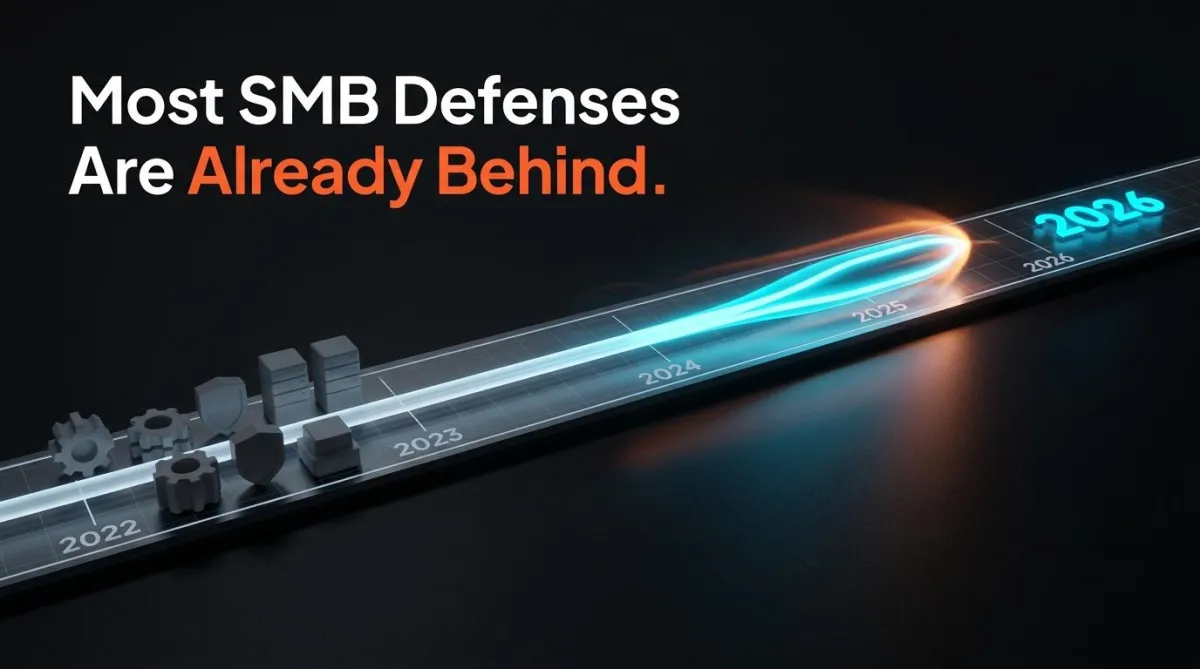
The 2026 Reality: Why Most SMB Ransomware Defenses Are Already Behind
Quick Answer: Most small business ransomware defenses were designed for a 2021 threat. The current attacker uses AI-generated phishing, breaches you in days instead of weeks, steals data rather than encrypting it, and exploits unpatched systems most SMBs do not even know are vulnerable. The cost gap between defended and undefended businesses has never been wider.
Most SMBs do not realize how much their cybersecurity has fallen behind.
The setup looks fine on paper. There is antivirus on every machine. Maybe a firewall. Probably some kind of backup.Employees were trained at some point. Passwords are required to be complex.
But the threats have evolved much faster than most defenses. And the gap is widening by the month.
In 2026, ransomware does not look like it did even three years ago. It moves faster. It is powered by AI. It does not always encrypt anything. And it is overwhelmingly aimed at SMBs.
This is what is quietly costing small businesses the most, and what most defenses are missing.
The Gap Between 2021 Defenses and 2026 Attacks
The way SMBs were told to defend against ransomware five years ago was reasonable for that time:
Install antivirus
Train employees on phishing
Back up data
Avoid suspicious links
Use a firewall
Most SMBs still operate roughly within that model. The problem is that attackers do not.
The current attacker:
Uses AI to craft phishing that bypasses traditional training
Exploits unpatched edge devices like VPNs and firewalls as a leading entry point
Moves from access to ransomware in days, not months
Steals data and skips encryption entirely
Targets backups first to make recovery impossible
Operates through Ransomware-as-a-Service infrastructure with industrial scale
Old defenses against new attacks is exactly the gap that ends with a ransom demand on the screen.
Where the Real Cost Shows Up
The ransom itself is the smallest part of the cost.Most SMBs do not realize what an attack actually does until they are in the middle of one.
Downtime
Industry incident reports put average ransomware downtime in the range of three to four weeks. That is nearly a month of orders not being processed, customers not being served, and employees unable to work productively.
Recovery
Recovery costs add up quickly for SMBs. They include incident response, system rebuilds, legal fees, regulatory penalties, customer notifications, and lost productivity during recovery. According to industry research, total recovery often costs many times the original ransom demand.
Lost Trust
Customers who learn their data was exposed do not always come back. Partners reconsider integrations. Insurance premiums rise. Some industries require breach disclosure that gets reported publicly.
Survival Risk
For some SMBs, a major ransomware attack creates a survival-level event the business never fully recovers from. Months of recovery costs, lost contracts, and ongoing reputation damage can strain operations long after systems are restored.
The cost of a serious attack often exceeds the cost of years of strong cybersecurity.
Where SMB Defenses Are Quietly Breaking Down
If you are not seeing alerts, it is easy to assume nothing is wrong. But the most damaging gaps are usually the ones that are invisible until they are exploited.
Unpatched Systems
Exploited vulnerabilities are now a leading root cause of ransomware. Most SMBs patch when they remember or when something forces it. Modern attackers automate the scanning and exploitation of known vulnerabilities within hours of disclosure.
Stolen Credentials
Another common entry point. If MFA is not on every business account and identity activity is not beingmonitored, a single stolen password from a different breach can be all an attackerneeds.
AI-Generated Phishing
Annual training and a quarterly phishing test are not enough anymore. Microsoft's 2025 Digital Defense Report found that AI-generated phishing achieved a 54% click-through rate compared to 12% for traditional phishing, making it roughly 4.5 times more effective. AI-generated phishing emails are personalized, contextually accurate, and far harder for the average employee to spot.
Untested Backups
Many SMBs have backups. Far fewer have backups that have actually been restored.And many backups can be encrypted or deleted by the same attacker who breaches the main network. Without immutability and isolation, backups are a comforting story, not a safety net.
No 24/7 Monitoring
Ransomware attacks now move from access to payload in days rather than weeks. If you are not monitoring 24/7, you are likely finding out about the attack after the damage is already done, and often through an external party rather than your own systems.
Why More Tools Will Not Fix This
The instinct when something feels off is to buy another tool.
A new firewall. Another monitoring platform. A bigger backup solution.
But adding tools to a disconnected setup usually creates more noise, not more protection. Most SMBs already have more security software than they are getting value from. The gap is not the number of tools. It is whether they are connected, configured, monitored, and tested as part of one system.
A defense built piece by piece does not add up to resilience. A defense designed as one system does.
What Modern Ransomware Defense Looks Like
A 2026 defense connects five layers, each one closing a specific attack path:
People trained to recognize modern AI-generated phishing
Identity and access controls that block stolen credentials
Patched and monitored systems with EDR on every device
Immutable, isolated, regularly tested backups
24/7 detection and response with a documented incident plan
When these layers work together, attackers do not have a clean path in. And when they do get in, you find out fast and contain it before it spreads.
The Cost of Doing Nothing
The status quo is not free. It is just hidden.
Every month without a modern ransomware defense, the gap between attacker capability and SMB defense gets wider. The cost shows up eventually, and when it does, it is almost always larger than what proactive defense would have cost.
For SMBs, the math is simple. Strong, layered defense costs a fraction of a single breach. Most SMBs that close their gaps before an attack avoid the worst outcomes. Most that wait, do not.
Find Out Where You Are Exposed
If your defense was built for the 2021 ransomware playbook, it is behind. The good news is that most gaps can be closed quickly once you know where they are.
We help SMBs identify exactly where their current setup is exposed, what is costing them the most, and the fastest practical steps to close the gap.
A free security assessment will show you what is working, what is missing, and what to do next.
Contact us to schedule your assessment and find out where your business is most at risk.
Frequently Asked Questions
How do I know if my current ransomware defense is behind?
If you do not have MFA on every account, immutable backups, 24/7monitoring, a defined patching cadence, or a tested response plan, you are behind. Most SMBs are.
What is the most common entry point for ransomware in 2026?
Exploited vulnerabilities in unpatched systems are now a leading entry point, followed closely by stolen credentials and AI-generated phishing.
Are backups still enough to protect against ransomware?
Not on their own. Attackers now target backups directly. And many modern attacks skip encryption entirely, stealing data and threatening to release it. Backups need to be immutable, isolated, and tested, and they need to be part of a broader defense.
How much does a ransomware attack actually cost an SMB?
IBM's 2025 Cost of a Data Breach Report put the average global breach cost at $4.4 million. For SMBs, recovery often costs many times the original ransom demand once downtime, system rebuilds, regulatory penalties, and customer impact are factored in.
How quickly can I close the biggest gaps in my defense?
Most SMBs can close their highest-priority gaps within 60 to 90 days. A security assessment shows you which gaps matter most and the fastest practical path to fix them.