Why Are Smart CTOs Choosing Co-Managed IT Over Fully Outsourced And Is It Right for Your Business?
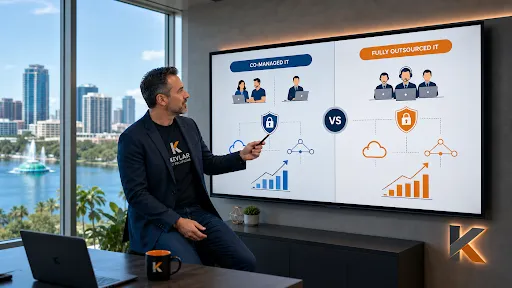
A smart CTO does not choose an IT model because it sounds popular. They choose it because it matches the company’s risk, growth stage, internal talent, budget, compliance needs, and operational pressure. That is why co-managed IT services Orlando businesses are using have become a serious option for leadership teams that do not want to fully outsource technology, but also know their internal team cannot carry every responsibility alone.
Fully outsourced IT can be a good fit for companies with no internal IT department. But for businesses that already have technical staff, fully outsourcing everything may create unnecessary friction. Internal teams often understand the company’s people, systems, culture, and priorities better than anyone outside the organization. The challenge is that they may not have enough time, tools, or specialized support to handle everything at the level the business now needs.
Co-Managed IT Is Not a Compromise. It Is a Strategy.
Some leaders see co-managed IT as a halfway option between internal IT and outsourced IT. That is too shallow. A strong co-managed model is not about splitting responsibilities randomly. It is about designing a smarter operating structure.
Your internal team keeps ownership of the areas where they create the most value. The external IT partner adds capacity, coverage, tools, and specialized expertise where the business has gaps. When done correctly, co-managed IT gives the company more control, not less. For example, your internal team may continue managing business applications, vendor relationships, and department-specific technology needs. The co-managed partner may support help desk tickets, cybersecurity monitoring, backup oversight, patch management, network maintenance, or project work. The point is to avoid forcing one team to do everything.
Why CTOs Are Moving Away From the All-or-Nothing IT Model
The old IT decision was simple: build an internal department or outsource everything. That model does not fit many growing businesses anymore. Technology has become too connected to daily operations, security, customer experience, compliance, remote work, and business growth.
A CTO may not want to hand over the entire IT environment to an outside provider. At the same time, they may know that hiring every needed specialist is expensive and unrealistic. A single internal employee cannot be the help desk, cybersecurity analyst, cloud engineer, network admin, backup specialist, documentation manager, and strategic advisor at the same time. This is where managed IT services Orlando providers can support a more practical model. Co-managed IT lets leadership keep internal knowledge while adding professional depth around it.
When Fully Outsourced IT Makes Sense
Fully outsourced IT is not wrong. It can be the right fit for smaller businesses, companies with no technical staff, or organizations that want one provider to manage nearly every part of their technology environment. It can simplify accountability and reduce the need for internal hiring.
For a company that does not have internal IT, fully outsourced support may be the cleanest option. The provider handles user support, devices, security, backups, cloud systems, network issues, and technology planning. That model can work well when the business needs complete coverage and does not have technical leadership in-house. The problem starts when a company already has capable internal IT staff but treats outsourcing as the only way to relieve pressure. In that case, full outsourcing can create confusion, duplicate work, and even internal resistance. Co-managed IT may be the better fit because it supports the existing team instead of pushing them aside.
When Co-Managed IT Is the Better Choice
Co-managed IT is usually the stronger choice when your business has internal IT talent but lacks enough capacity, coverage, or specialized expertise. This is common in growing Orlando businesses where the internal team knows the environment well but is buried in daily support requests and security demands.
It is also useful when leadership wants to improve cybersecurity without hiring a full security team. A co-managed partner can help with endpoint protection, multi-factor authentication, email security, patching, backup monitoring, network visibility, and incident response planning. The National Institute of Standards and Technology explains through its cybersecurity framework that managing cybersecurity risk requires structure, governance, protection, detection, response, and recovery. For many companies, those responsibilities are too important to leave to an overloaded internal team with limited time.
The CTO’s Real Question: Control or Capacity?
The decision is not really internal IT versus outsourced IT. The better question is: where does your business need more control, and where does it need more capacity?
If your internal team understands the business systems deeply, keep them close to those systems. If they are drowning in help desk tickets, give them support. If cybersecurity is becoming too complex, bring in specialized expertise. If backups are not being tested consistently, add monitoring and accountability. If network issues keep interrupting the business, strengthen infrastructure support.
A mature IT model does not protect ego. It protects the business.
For CTOs and leadership teams, this mindset is important. The goal is not to prove that internal IT can handle everything. The goal is to build an IT structure that supports growth without creating hidden risk.
Co-Managed IT Can Protect Internal Knowledge
One underrated benefit of co-managed IT is that it helps preserve internal knowledge. Fully outsourced models can sometimes create distance between IT decisions and business realities. Internal employees may know why a certain department uses a tool a specific way, which executives need urgent support, or which workflows cannot be interrupted.
That context matters.
With co-managed IT, the internal team remains involved while the external partner adds support around them. The business keeps the value of internal knowledge while gaining stronger systems, better documentation, and broader technical coverage. This is especially useful for companies with industry-specific software, compliance requirements, or complex workflows. The provider does not need to replace the internal team’s knowledge. It needs to strengthen the environment around it.
Cost Should Not Be the Only Deciding Factor
Some companies compare fully outsourced IT and co-managed IT only by monthly cost. That is a mistake. The cheaper model is not always the better model. The right model is the one that reduces risk, improves productivity, supports growth, and gives leadership confidence.
A fully outsourced model may appear simpler, but it may not be ideal if your internal team still needs to stay heavily involved. A co-managed model may seem more layered, but it can produce better results when responsibilities are clearly defined. The real cost to watch is not just the provider fee. It is the cost of downtime, employee frustration, delayed projects, weak cybersecurity, poor documentation, missed alerts, and an internal team that burns out because leadership waited too long to support them.
What a Good Co-Managed Partnership Should Include
A strong co-managed relationship starts with clarity. Everyone should know who handles help desk requests, who manages security alerts, who owns backups, who handles user onboarding, who manages cloud access, who communicates with leadership, and how urgent issues are escalated.
The provider should not make the internal team feel replaced or ignored. They should act as an extension of the team. That means better communication, shared documentation, transparent ticketing, clear reporting, and practical recommendations. For Orlando businesses, this also means having a partner that understands local business needs and can support growth without adding unnecessary complexity. The best co-managed IT model should make life easier for internal IT, not create another layer of confusion.
Is Co-Managed IT Right for Your Business?
Co-managed IT may be right for your business if your internal team is capable but overloaded, if cybersecurity responsibilities are growing, if projects are being delayed, if support tickets are consuming too much time, or if leadership wants stronger IT coverage without fully outsourcing control.
Fully outsourced IT may be right if you have no internal IT staff, need complete support, or want one provider to manage the entire environment. Neither model is automatically better. The right answer depends on your business structure, internal skill set, risk profile, and growth plans. What smart CTOs understand is that IT is not just a department. It is an operating system for the business. If that system is under-supported, the whole company feels it.
Build the IT Model That Matches Your Business
The best IT model is not the one that sounds most efficient on paper. It is the one your business can actually operate with, scale with, and trust under pressure. For many Orlando companies, co-managed IT offers the right balance: internal control, external expertise, stronger security, better coverage, and less strain on the people already supporting the business.
Kevlar IT Solutions helps Orlando businesses design smarter IT support models through co-managed IT services, managed IT services, IT support, cybersecurity services, network security, and strategic IT consulting. If your internal team has the knowledge but not the bandwidth, the answer may not be replacing them or stretching them thinner. The stronger move is giving them the right partner so the entire business can move with more confidence.
FAQs
What is the difference between co-managed IT and fully outsourced IT for Orlando businesses?
Co-managed IT supports an existing internal IT team, while fully outsourced IT usually means an external provider manages most or all technology responsibilities. Orlando businesses with internal IT staff often choose co-managed IT when they need extra capacity, tools, or cybersecurity support.
Why do CTOs choose co-managed IT services in Orlando?
CTOs choose co-managed IT services Orlando companies provide because they can keep internal control while adding outside expertise, help desk support, security monitoring, backup oversight, and project assistance.
Is co-managed IT better than fully outsourced IT?
Co-managed IT is better when a company already has internal IT talent but needs more support. Fully outsourced IT may be better when a business has no internal IT department and wants one provider to manage the full environment.
Can co-managed IT improve cybersecurity for Orlando businesses?
Yes. Co-managed IT can improve cybersecurity by adding monitoring, patch management, endpoint protection, access controls, backup management, and incident response planning to support the internal IT team.