

CMMC Enclave Explained: When Do Contractors Need One?
Many defense contractors manage highly classified data while at the same time relying on the same IT infrastructure for day-to-day operations. When multiple employees, devices and applications are all on a network, it can be difficult to keep this information protected.
A CMMC enclave can be used to isolate systems used to process Controlled Unclassified Information (CUI) from non-CUI-related business functions. This can help contractors in effectively managing security, preparing for CMMC compliance, and setting parameters for their CMMC assessment.
What is a CMMC Enclave?
A CMMC enclave is a secure community of information technology resources utilized to store, process, or transmit CUI. It can contain computers, servers, applications, user accounts and network connections.
In one instance, a defense contractor could have its typical network for accounting and marketing and then have a different network for folks that work on government records and technical specifications.
This separate environment is typically referred to as a CUI enclave, since it's dedicated to the defense of sensitive government information.
Why Do Defense Contractors Use a Secure Enclave for CMMC?
Not every employee or business system needs access to CUI. Separating sensitive information can help contractors:
Restrict access to authorized users.
Reduce exposure across the general business network.
Focus security monitoring on sensitive systems.
Organize compliance documentation.
Establish a clearer CMMC assessment boundary.
A secure enclave for CMMC can simplify security management and security monitoring, but it does not automatically make a contractor compliant. All applicable security requirements must still be met.
When Do Contractors Need a CMMC Enclave?
An enclave may be useful when only certain employees or departments handle CUI.
For example, a manufacturer with 30 employees may have only eight people working with government project documents. It could create a separate environment for those employees rather than placing the entire company network within the same protected boundary.
An enclave may be worth considering when:
Only specific employees handle CUI.
Commercial and government projects use different systems.
The existing network contains many unrelated business applications.
The contractor wants to define a smaller assessment scope.
An enclave is not mandatory for every defense contractor. A company can also secure its entire enterprise network if that approach fits its operations and CMMC assessment scope.
CMMC Enclave Requirements
For contractors pursuing CMMC Level 2, security requirements are based on NIST SP 800-171 Revision 2, which contains 110 requirements.
Key areas include:
Access control: Limit access to authorized users.
Authentication: Verify user identities before granting access.
Audit and accountability: Record and review system activity.
Configuration management: Maintain secure system settings.
Incident response: Prepare for and manage security incidents.
Risk assessment: Identify and address security weaknesses.
System protection: Protect information moving through the environment.
Contractors must also maintain documentation, including asset inventories, network diagrams, and a System Security Plan (SSP).
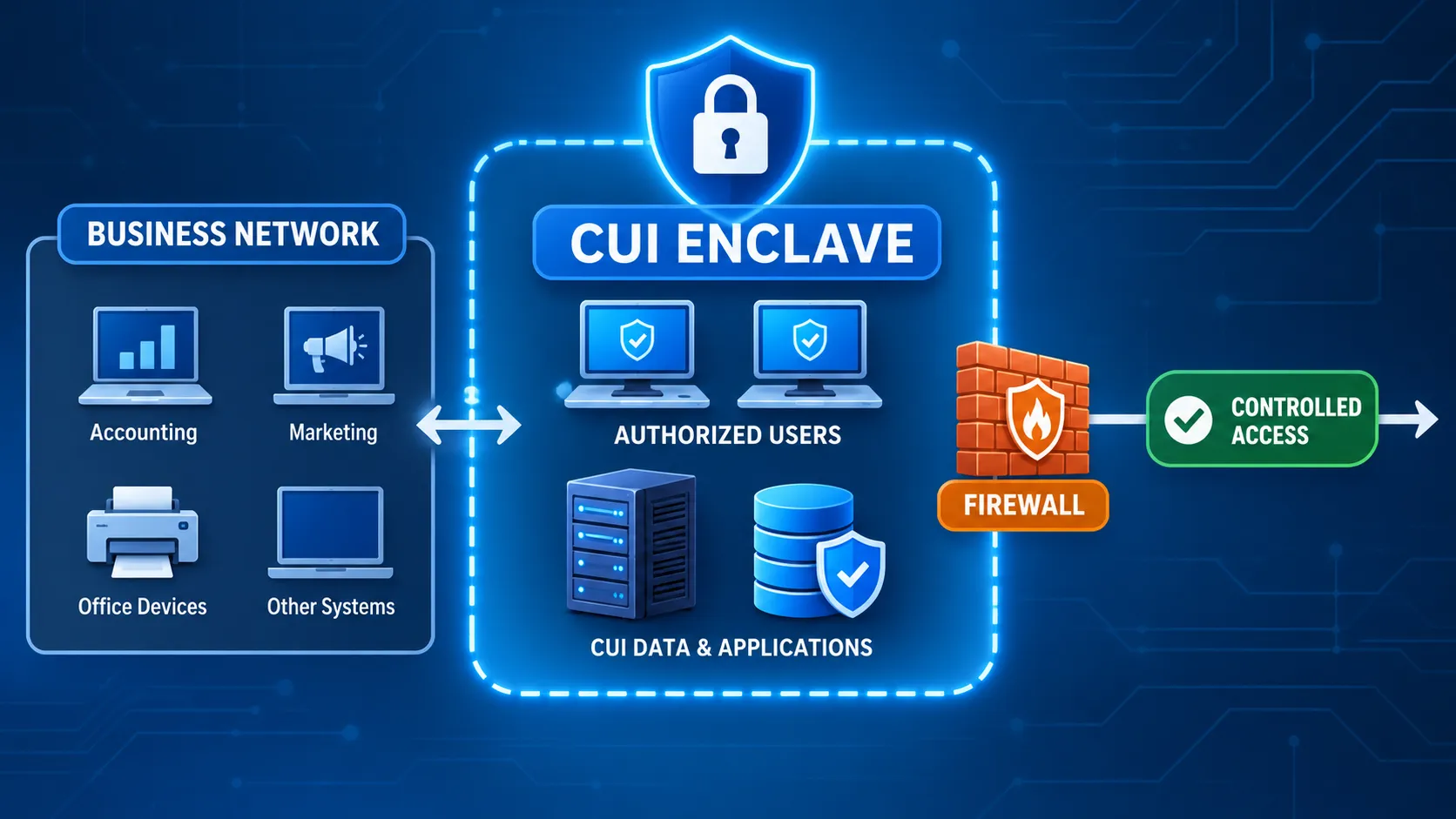
Understanding CMMC Enclave Architecture
A CMMC enclave architecture defines how users, devices, applications, and information interact within the protected environment.
A typical design may include:
Authorized users: Employees who need access to CUI.
Managed devices: Approved computers configured with security controls.
Identity management: Authentication and access permissions.
Network protection: Firewalls and segmentation controls.
Secure storage: Approved locations for CUI.
Monitoring: Tools that record activity and identify suspicious behavior.
Remote access and external services must also be considered. Systems that support or protect the enclave may affect its assessment scope.
What Is Included in a CMMC Level 2 Enclave?
A CMMC Level 2 enclave may include several types of assets:
Asset category | Purpose |
CUI Assets | Process, store, or transmit CUI |
Security Protection Assets | Provide security functions |
Contractor Risk Managed Assets | Are managed under documented risk-based policies |
Specialized Assets | Include certain specialized equipment and systems |
Out-of-Scope Assets | Meet the conditions for exclusion from assessment |
Contractors must identify and document their assets correctly. A computer does not become out of scope simply because CUI files are stored somewhere else; its actual role and connections matter.
How to Choose an Enclave Solution for CMMC Compliance
Choosing an enclave solution for CMMC compliance requires more than purchasing security software or moving files to the cloud.
Consider these steps:
Identify CUI: Determine which employees, devices, and applications handle sensitive information.
Review existing systems: Examine networks, cloud services, storage, and external connections.
Choose the right environment: Compare cloud-based and internally managed options based on security needs and business operations.
Check documentation: Ensure the solution supports asset inventories, network diagrams, security policies, and assessment evidence.
Plan ongoing security: Maintain updates, access reviews, monitoring, and incident response procedures.
Does Every Defense Contractor Need an Enclave?
No. Contractors may choose to scope their assessment of the CMMC for their entire enterprise network or for a particular enclave.
If the boundary is smaller, it could limit the scope of assessment assets directly within the boundary. But there are supporting systems and security needs that still need to be taken into account.
An enclave doesn't automatically receive another network's CMMC mark. A documentation and support of any inherited security implementation is required.
Conclusion:
A well-designed enclave can help defense contractors manage sensitive government information while providing separation from business activities. It can also help to get the security management and assessment preparation organized.
Contractors should determine the location of CUI used, the systems that support CUI, and select an environment that is appropriate for their security and business requirements before constructing one. Having a separate network is not sufficient to comply with CMMC.
Frequently Asked Questions
Is a CMMC enclave mandatory for Level 2?
No. Contractors may evaluate both their overall enterprise network and a well-defined enclave—wherever they choose, as long as a scope is well defined and meets applicable requirements.
Can a small contractor use a CUI enclave?
Yes. Small businesses can provide a separate system and workstation for the CUI handling process.
Can a cloud environment qualify as a CMMC enclave?
Yes, if the cloud services and configuration comply with the applicable security and assessment requirements.
Can an enclave reduce assessment costs?
It may reduce the number of assets directly included in an assessment. There still are supporting systems and documentation needs to be addressed, though.
Does an enclave guarantee CMMC compliance?
No. It will help to organize and protect the environment, but the contractors will still need to provide and prove all the security requirements.