
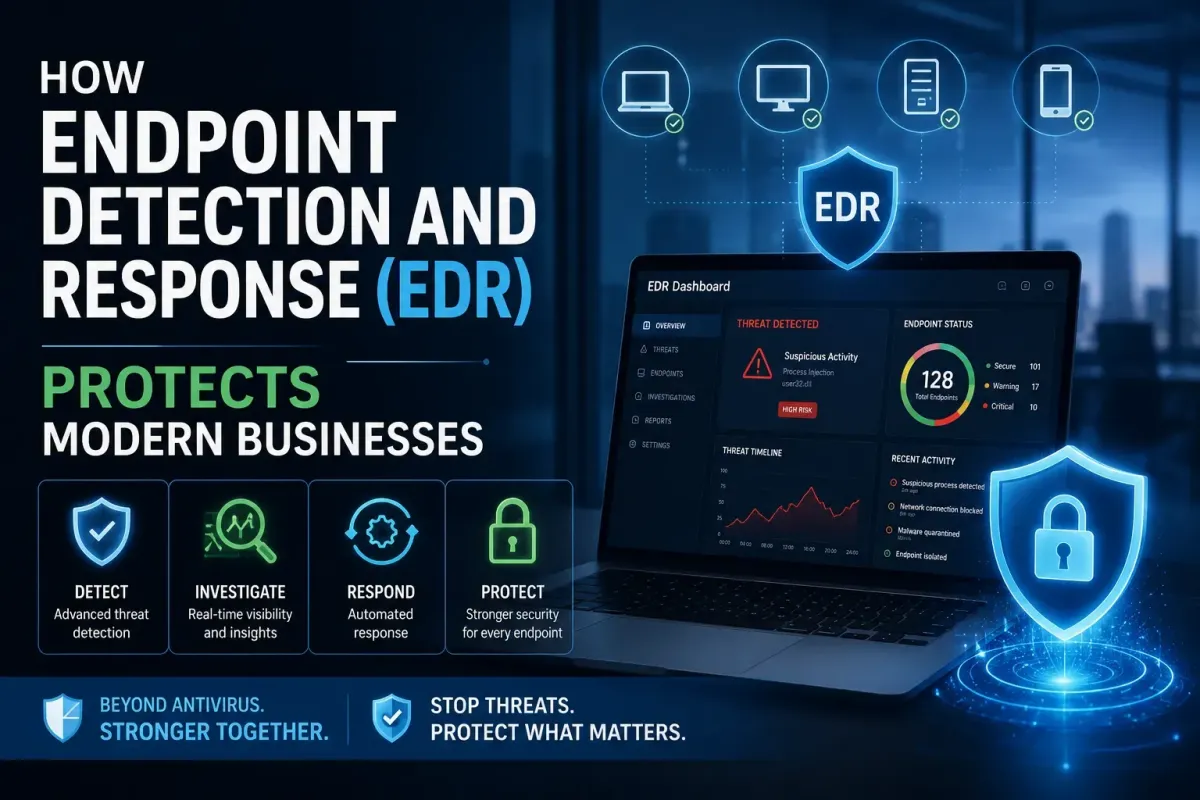
How Endpoint Detection and Response (EDR) Protects Business
Traditional antivirus is just not enough anymore. You install it, you update it, you hope it catches everything. But the bad guys have gotten smarter. They use fileless malware that lives in memory. They steal passwords and log in like employees. The average time from initial breach to spreading to another computer is now just 48 minutes. Your antivirus often does not even see them coming.
That is where Endpoint Threat Detection and Response (EDR) comes in. Unlike antivirus, which blocks known threats, Endpoint Detection and Response is built to catch the sneaky ones. It watches what endpoints actually do, detects unusual behavior, and helps you respond before the damage gets out of control .
How EDR Actually Works
Think of antivirus as an Endpoint Security guard checking IDs at the door. It stops things that look suspicious based on a known watchlist. Endpoint Detection and Response works differently—it is like security cameras inside your building, watching everything that happens after people get in.
Endpoint Detection and Response works by installing a lightweight agent on every device—laptops, desktops, servers, even phones and printers . This agent continuously monitors activity: what processes are running, what files are changing, what network connections are being made, and who is logging in .
When something looks off, it does not just send an alert. It gives you the full picture—the process that started it, the files it touched, where it came from, and what it is trying to do . If it detects something serious like ransomware protection, it can automatically isolate the device from the network, kill the malicious process, and even help you roll back encrypted files.
Why Most Businesses Need EDR Now
The reality is simple. Cyber criminals have moved past the old playbook. Studies show that 79% of detections are now malware-free, attackers using stolen credentials, legitimate admin tools, and other methods that leave no malicious file for antivirus to scan. Fileless malware in particular is responsible for 86% of critical incident detections because traditional antivirus simply does not have a file to match against a signature .
Endpoint Detection and Response gives you visibility into what is happening on every endpoint across your business, which is crucial when employees work from home or use their own devices. It also provides the forensic data you need for cyber insurance policies and regulatory compliance, with many insurers now requiring EDR for coverage.

Key EDR Features You Should Know
Good Endpoint Detection and Response solutions include several critical capabilities.
Real-time behavioral analysis establishes a baseline of normal activity and flags anomalies.
Automated response means threats are contained immediately, giving you time to investigate without them spreading.
Threat hunting tools allow analysts to proactively search for hidden attackers.
Forensic investigation provides complete attack timelines and process trees.
And MITRE ATT&CK mapping helps teams understand adversary behavior and communicate findings effectively .
Endpoint Detection vs Antivirus: They Work Better Together
Antivirus remains a crucial first line of defense for the massive volume of everyday malware, while Endpoint Detection and Response handles what gets through. A layered strategy combining both delivers stronger protection than either tool alone.
Conclusion:
Endpoint Detection and Response has become the new standard for protecting modern businesses . It gives you the visibility, detection, and response capabilities to catch threats that traditional antivirus misses. Whether you are a small business or a large enterprise, implementing EDR is no longer optional—it is essential for staying safe in 2026 and beyond .
Frequently Asked Questions
What is Endpoint Detection and Response?
EDR security keeps an eye on your devices for anything fishy. It spots threats and helps you react fast. Antivirus catches the known stuff. EDR catches what sneaks past.
How does EDR protect against ransomware?
EDR watches for file encryption behavior — that's how it spots ransomware. When it detects it, it can isolate the infected device, shut down the bad processes, and even help you get encrypted files back. Stops it from hopping across your network.
What's the difference between EDR and antivirus?
Antivirus scans for known malware signatures it catches stuff antivirus misses, like fileless malware, zero-day exploits, and attacks using stolen passwords. Plus it gives you tools to dig in and figure out what happened.
Is EDR replacing antivirus?
No — EDR builds on antivirus. You still need antivirus to block the massive amount of known malware out there. EDR handles the stuff that gets through. The smart move is using both.
What types of threats does EDR detect that antivirus misses?
EDR catches fileless malware that runs in memory without leaving a trace. Zero-day exploits that have no signature. Attacks using stolen credentials. And attacks that abuse legit tools like PowerShell. Those are the ones causing most of the serious incidents today.
Is EDR necessary for small businesses?
Yeah, absolutely. Small businesses get hit just as often, sometimes more because their defenses aren't as strong. A lot of cyber insurance policies now require EDR for coverage. And there are affordable options out there for smaller companies.
How long does it take to deploy EDR?
Depends on how complex your environment is. Agents can go on pretty quick, but full setup and tuning might take a few weeks. Unlike antivirus, EDR needs some time to learn what normal looks like for your systems.
What is the cost of EDR?
Costs vary — usually a subscription per device. EDR costs more than antivirus alone, but recovering from a ransomware attack costs way more. Most businesses figure the investment pays off.
Can EDR be integrated with other security tools?
Yes, most EDR solutions play nice with SIEM, SOAR, and other security platforms. That gives you a bigger picture and automated workflows across your entire security setup.
What is a zero-day attack and can EDR stop it?
A zero-day attack exploits a vulnerability nobody knows about yet. EDR can stop it because it looks at behavior, not signatures. That's what makes it so powerful.