Hosted VoIP vs On-Premise Phone Systems: Which Is Better?
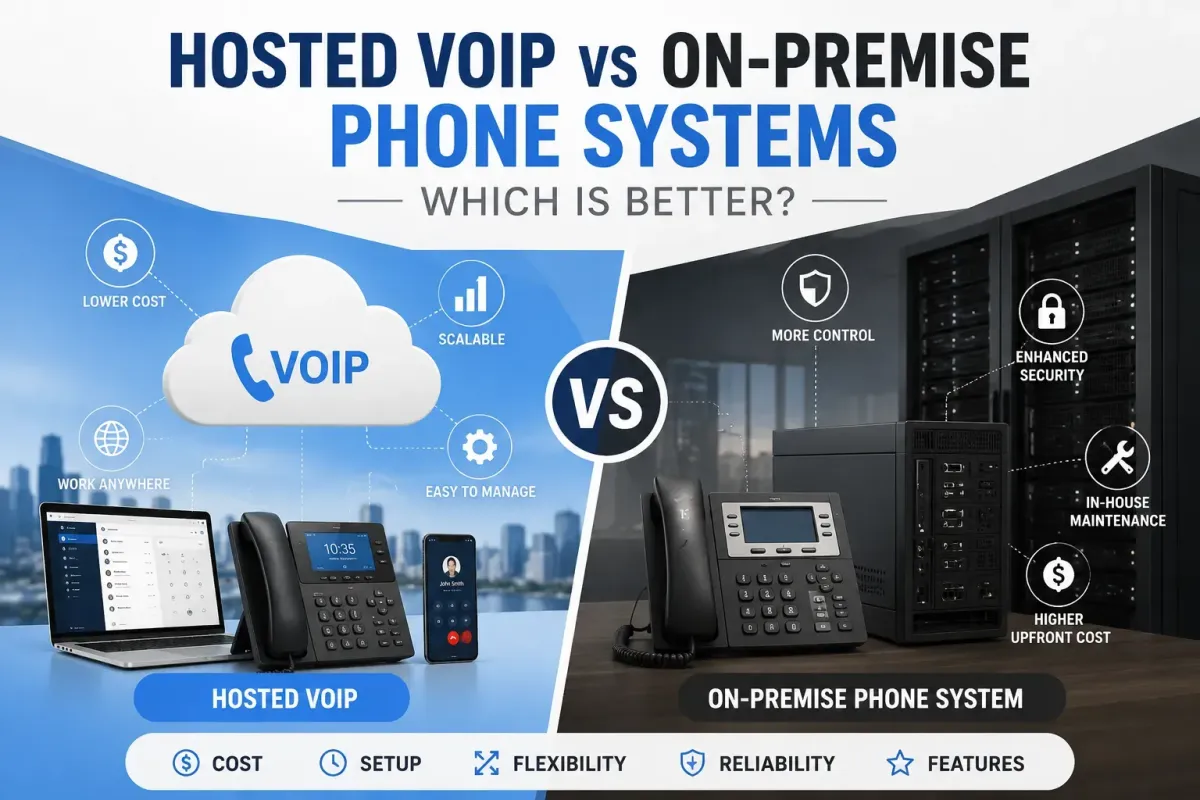
Choosing a Hosted vs On-Premise Phone System is not exciting. But getting it wrong costs you money. And headaches. And customers. You have two main options. Hosted VoIP. Or on-premise. One lives in the Cloud Phone System. One lives in your office. They work differently. They cost differently. They serve different needs.
So which one is right for you?
What Actually Is the Difference?
The short answer: hosted is a service, on-premise is equipment.
On-premise means you buy hardware, install it in your office, and manage it yourself. Servers. Wiring. Phones. All on your site. Your IT team handles everything. Updates. Repairs. Security. It is all on you.
Hosted VoIP Phone System means the provider handles everything off-site. You pay a monthly subscription. You get access through the internet. No servers in your closet. No wiring headaches. No IT calls for every small issue.
Hosted vs On-Premise Phone System is really about control versus convenience.
The Cost Question That Everyone Asks
Because that is where things get real.
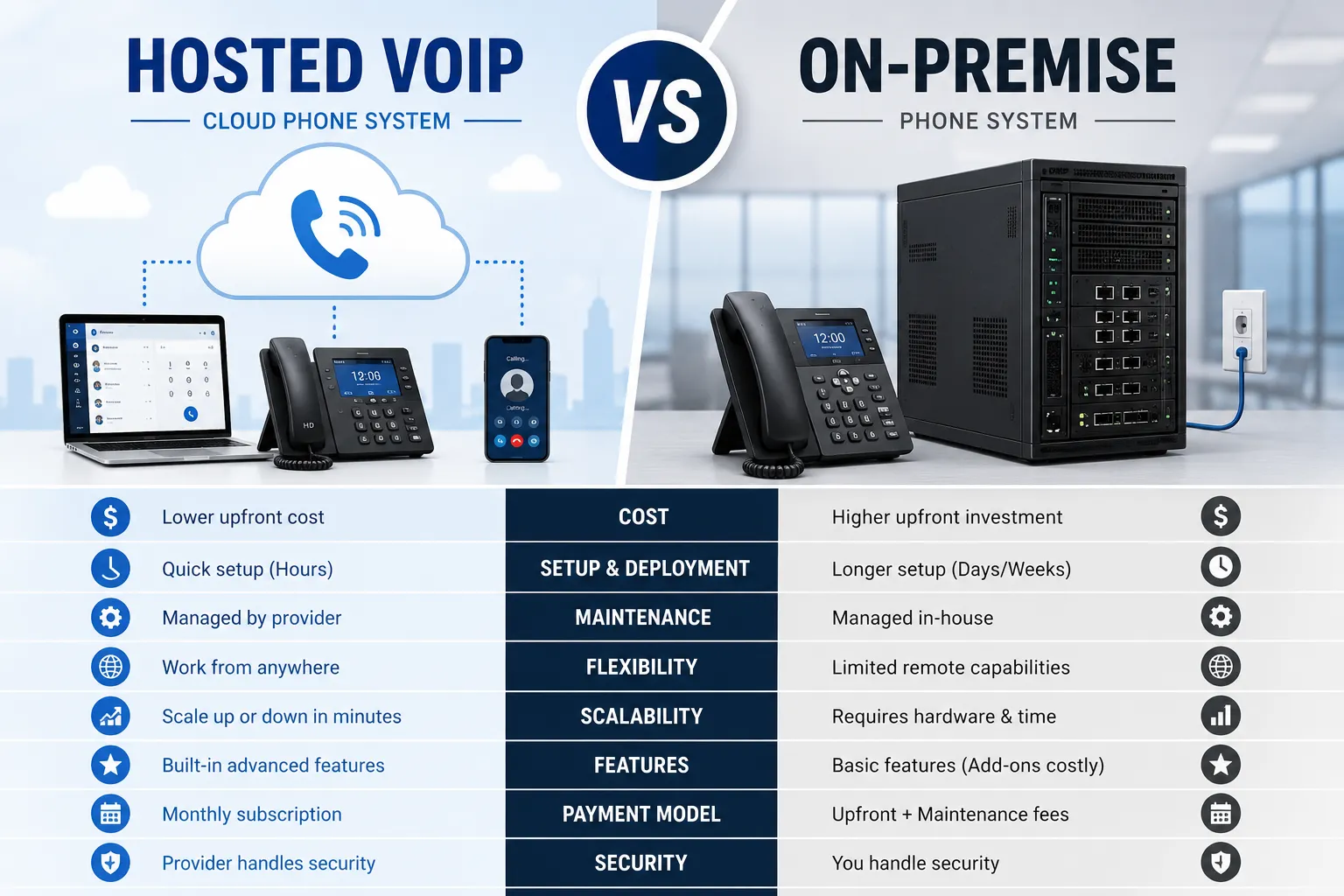
On-premise costs hit you upfront. Hardware, servers, phones, installation. Usually between $10,000 and $80,000 depending on your size. Then you pay annual maintenance contracts. About 10-15% of the hardware value each year. Over five years, a 25-person VoIP on Premise setup runs $40,000 to $70,000.
Hosted VoIP spreads costs out. Monthly per-user fees, typically $15 to $55 per seat. For a 10-person team, expect $150 to $500 monthly. Over five years, that same 25-person team costs $25,000 to $50,000. Often cheaper overall.
Here is the catch. Cloud VoIP for Business and on-premise can be cheaper long-term if you stay small and stable. But most businesses grow. And growth means more hardware. More installation costs. More headaches.
What Actually Matters Day to Day
This is where the two Hosted vs On-Premise Phone System feel very different.
Setup and Deployment
On-premise takes days or weeks. Professional installation. Physical wiring. Configuration of servers and phones. You wait for technicians. You block off time. You pray nothing goes wrong.
Hosted VoIP takes hours. Software-based. Add users in a few clicks. No hardware needed. Your team can be up and running the same day.
Maintenance and IT Dependence
On-premise means you own the problems. Updates. Patches. Repairs. All internal. If something breaks, your Managed IT Support provider or IT team fixes it.
Hosted VoIP means the provider handles everything. Automatic updates. Security patches. Hosted vs On-Premise Phone System monitoring. Your team focuses on business, not phones.
Remote Work and Flexibility
This is where hosted VoIP wins by miles.
On-premise was built for offices. Supporting remote workers is complicated. Requires VPNs, extra hardware, complex setups. It just was not designed for today's hybrid world.
Hosted vs On-Premise Phone System works anywhere. Employees use their laptop, mobile phone, or any device with internet. Same features. Same number. Same professionalism. Whether they are at home, a coffee shop, or another country.
Scaling Up and Down
On-premise scaling is painful. Adding users means buying more hardware. Installing more lines. More cost. More time.
Hosted VoIP scaling is a few clicks. Add a user. Remove a user. Pay only for what you use. Growing fast? No problem. Seasonal changes? Easy to adjust.
The Control Question
Some businesses want control. Real control.
On-premise gives you that. Your data sits behind your firewall. You choose your security protocols. You customize everything. You are not dependent on a provider's uptime.
But control comes with responsibility.
If your internet goes down, on-premise still works internally. You can still call between extensions. That is a real advantage for operations that cannot afford any downtime.
However, hosted VoIP providers offer robust reliability. Carrier-grade SLAs, redundant data centers, automated failover. The real weak link is your internet connection. If your office internet fails, you lose phone service unless you have backup connections.
Features and Integrations
Here is where Hosted vs On-Premise Phone System pulls ahead.
Hosted systems come with advanced features built in. Auto attendants, call recording, voicemail-to-email, video conferencing, team chat, real-time analytics. Native integrations with CRM tools like Salesforce and HubSpot.
On-premise systems offer basic features. Call forwarding. Voicemail. Simple routing. Integrating with other software often requires custom development or costly upgrades.
So Which One Is Better?
It depends on your business.
Hosted VoIP is better for most businesses today, especially when selecting the right VoIP Phone System for Small Business.
On-premise might still make sense if you are in a regulated industry with strict data sovereignty rules, have stable size and predictable needs, or already have significant hardware investment and IT expertise.
Some businesses do both. Hosted for remote teams and new offices. On-premise kept for headquarters or specialized analog needs.
The decision is rarely all-or-nothing.
Conclusion:
Hosted vs On-Premise Phone System is winning for a reason. It is cheaper upfront, easier to manage, scales effortlessly, and supports the way people actually work today. But control matters. And on-premise delivers that.
Think about what your business really needs. Then choose accordingly.
Frequently Asked Questions
Which is more cost-effective, hosted VoIP or on-premise?
Hosted VoIP is easier on your budget, monthly fees you can count on. On-premise hits you hard upfront but might save you money way down the road. For a 25-person team over five years, hosted runs about $25,000 to $50,000. On-premise? You're looking at $40,000 to $70,000.
Does hosted VoIP work for remote teams?
Yeah, work anywhere you get the internet. Laptops, phones, doesn't matter. As long as you're connected, you're good.
Is an on-premise phone system more secure?
It keeps your data behind your own firewall, good for strict rules. But hosted VoIP has strong security too. Honestly, it depends more on how you set it up than where it sits.
What happens if my internet goes down with hosted VoIP?
If your internet dies, your phones die too — unless you got a backup. On-premise? You can still call between desks even when the internet's out.
How do I scale a hosted VoIP system?
Add or remove users in minutes through an online dashboard. No new hardware to buy.
What are the key features of hosted VoIP?
Auto attendants, call recording, voicemail-to-email, video meetings, analytics, mobile apps, and CRM integration. Everything you need.
Does on-premise phone system require IT expertise?
Yeah, definitely. You need IT staff to maintain, update, troubleshoot, and secure it. Not a plug-and-play thing.
Can I switch from on-premise to hosted VoIP?
Yeah, you can. A lot of businesses go hybrid or move gradually. Hosted VoIP makes it pretty smooth.
Which phone system is better for small businesses?
Hosted VoIP, hands down. Lower cost, no IT headaches, and it grows with you.