
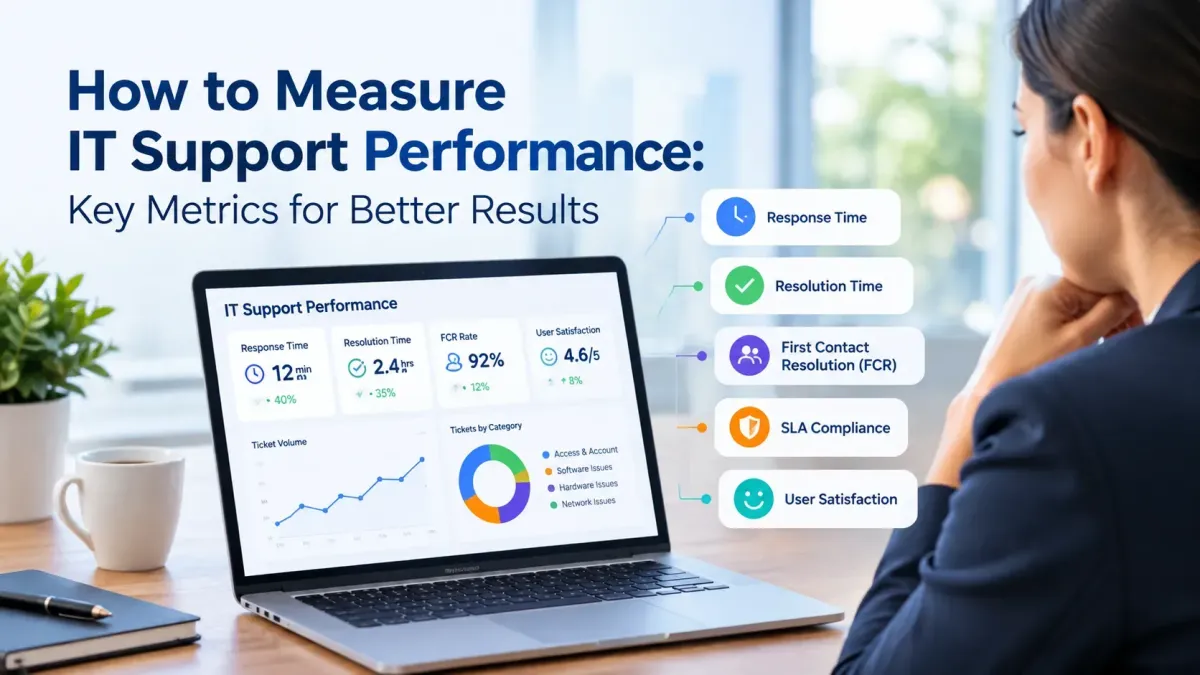
How to Measure IT Support Performance: Key Metrics
A good IT support doesn't just involve solving issues when they arise. Businesses should be aware of the speed at which the issues are resolved, whether users are happy, and if issues are reoccurring. That's where IT performance metrics come in handy.
Monitoring the correct numbers can help businesses determine the effectiveness of their IT team or service provider and identify areas for improvement.
Why are IT Performance Metrics Important?
From technical troubleshooting and access to systems, to network issues and security concerns, IT teams are responsible for it all. It can be challenging to know whether support is having an impact without clear measures.
Information technology metrics are quantitative measurements of the IT services and support. They can indicate the areas of delay, the most common problems, and if the support team is achieving the goals of its services.
The focus should be on metrics that align IT performance to the true requirements of the business, as opposed to the numbers being reported for the sake of numbers.
What IT Support Metrics Should Businesses Track?
Businesses can get a more detailed understanding of service quality with several IT support performance metrics.
IT Support Response Time
The IT support response time refers to the time elapsed between a user's request and the IT support's acknowledgment or reply.
A quicker response time may help minimize frustration, particularly if it is a problem that is hindering an employee's ability to perform their job responsibilities. But response time must be assessed based on the severity of the issue. There is no need to have the same target for a critical outage and a simple password request.
IT Support Resolution Time
IT support resolution time is the amount of time it takes to resolve an issue once it's reported.
This data can be used to discover common time delays. If some ticket types are always taking a longer time to be solved, this can imply that the business could require better documentation, extra training, improved tools, or a way of running the support process.
First Contact Resolution Rate
First contact resolution rate (FCRR) is the percentage of support requests that are resolved the first time they are contacted by the customer.
A higher rate may mean that support staff are knowledgeable and have the ability to resolve standard issues without further follow-up or escalation. Even so, it needs to be studied in conjunction with the complexity of the issue and satisfaction of the users.
Which IT Support KPIs Matter Most?
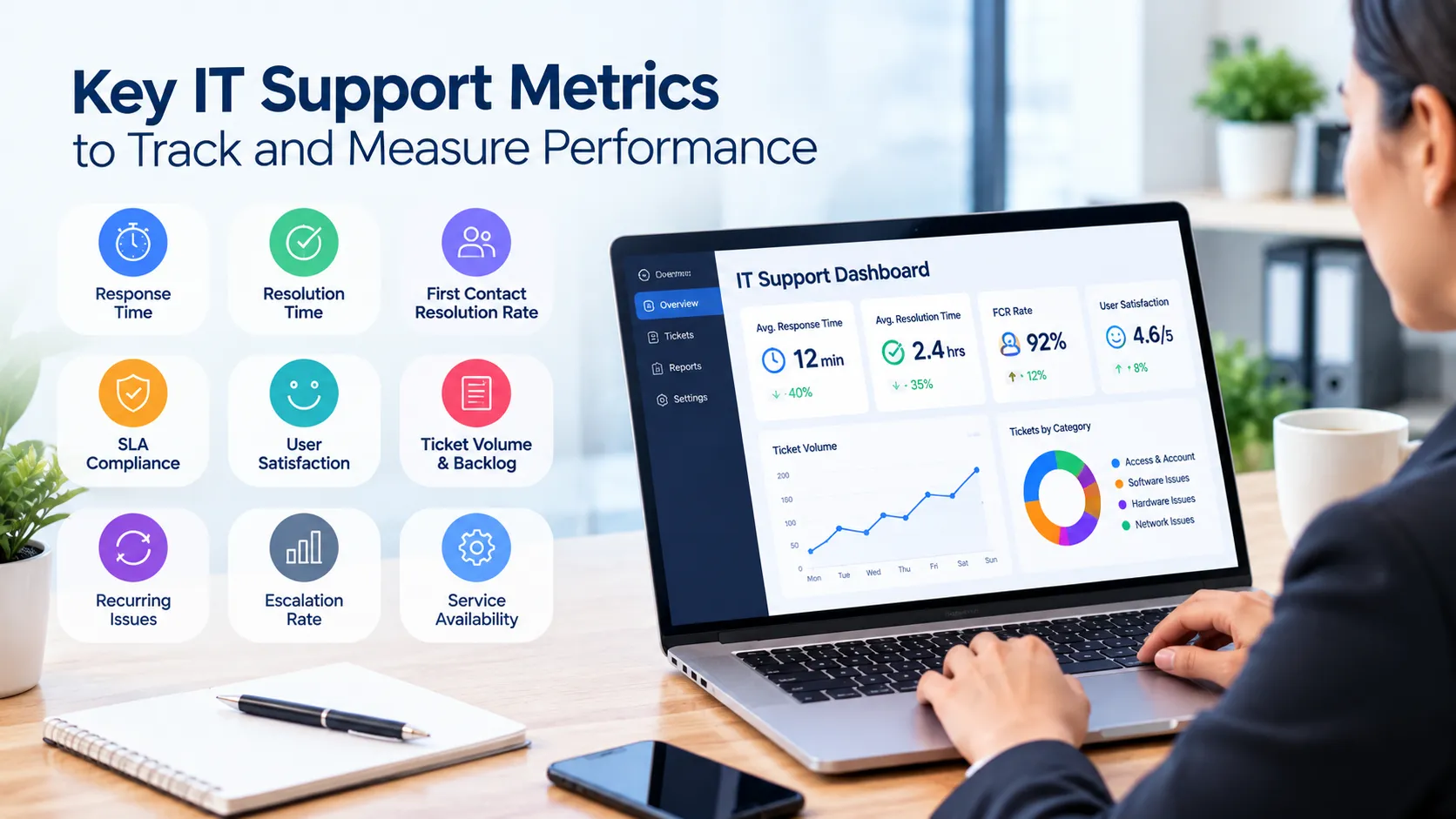
IT support KPIs should reflect the goals of the business. Common examples include:
Response time
Resolution time
First contact resolution rate
Number of open and overdue tickets
Ticket volume by category
Escalation rate
User satisfaction
Recurring issue rate
SLA compliance
These information technology key performance indicators can help managers identify trends instead of relying only on individual complaints. Businesses can also use IT Help Desk SLA standards to define measurable response and resolution expectations for different support priorities.
For example, a support team may close a large number of tickets but still have poor performance if users frequently reopen tickets or experience the same problem repeatedly.
How to Measure IT Support Performance
The first step to understanding how to measure IT support performance is to establish clear goals.
First, you need to be clear on what is good support. This may be something that needs to be done in a hurry in a set time frame, a set time frame to get a routine request done, or an agreed level of customer satisfaction.
Then, businesses using helpdesk services can gather consistent data through a help desk or ticketing system. When measuring tickets in the same manner over time, any change or recurring issues become easier to be identified.
It's also beneficial to go over the numbers on a frequent basis, not just at the end of the year. Reporting monthly or quarterly can help you identify trends early and provide time for your IT team to get back on things.
Look Beyond IT Support Numbers
Traditional help desk metrics are not necessarily helpful measures. More comprehensive IT business metrics can link technology performance to business activities.
For instance, businesses can monitor downtime of systems, how often applications are unavailable, common technical problems, employee productivity affected, and expenses of supporting various systems.
These measurements give a more comprehensive picture on how well IT is working to achieve the business objective.
Use Metrics to Improve IT Support
Metrics shouldn't be used to improve the team, just to produce another report.
When response times are getting longer, management can explore staffing or volume of tickets. If resolution is a problem, then there could have been a lack of documentation or technical resources for the team. Low first contact resolution could be due to the lack of access to systems or training.
However, remember that you don't have to fixate on a single measure. Quickly closing tickets may not be indicative of support, if the user is not happy or if problems persist.
The best way to do this is to consider several of these IT performance metrics in combination and identify patterns.
Conclusion:
By measuring IT support, businesses can gain a better understanding of the quality, efficiency, and areas for improvement. For businesses that rely on external providers, managed IT support can also help establish consistent processes and performance expectations. Response time, resolution time, first contact resolution, satisfaction, and SLA compliance are metrics that can be helpful in understanding support performance on a day-to-day basis.
The appropriate measurements will depend on each business. The key is to select appropriate KPIs that align with the business's requirements and leverage these metrics to enhance the overall IT support journey.
Frequently Asked Questions
What are IT performance metrics?
IT performance metrics are measurable data points used to evaluate IT services, support efficiency, system performance, and the quality of technology services provided to a business.
What is a good IT support response time?
There is no single response time that fits every business. Targets should reflect issue severity, business needs, staffing, and the service level agreement in place.
What is IT support resolution time?
IT support resolution time measures how long it takes to resolve a technical issue after it has been reported or assigned to the support team.
Why is first contact resolution important?
It shows how often support teams can solve an issue during the first interaction, reducing repeated communication and helping employees return to work sooner.
What are common IT support KPIs?
Common KPIs include response time, resolution time, first contact resolution, ticket volume, escalation rate, SLA compliance, and user satisfaction.
How often should businesses review IT metrics?
Many businesses review IT metrics monthly or quarterly. More frequent reviews may be useful for teams handling high ticket volumes or critical systems.
Can IT metrics improve employee productivity?
They can help identify technical problems that interrupt work. Tracking recurring issues, downtime, and resolution times can show where IT improvements may reduce disruption.
What are information technology key performance indicators?
They are measurable indicators used to evaluate whether IT services and support are meeting defined operational and business objectives.
Should businesses track ticket volume?
Yes. Ticket volume can show workload patterns and identify recurring issues. However, it should be considered alongside complexity, resolution time, and user satisfaction.
What is the best way to measure IT support performance?
Use a combination of support KPIs rather than relying on one number. Response time, resolution time, first contact resolution, satisfaction, and SLA performance provide a more complete picture.