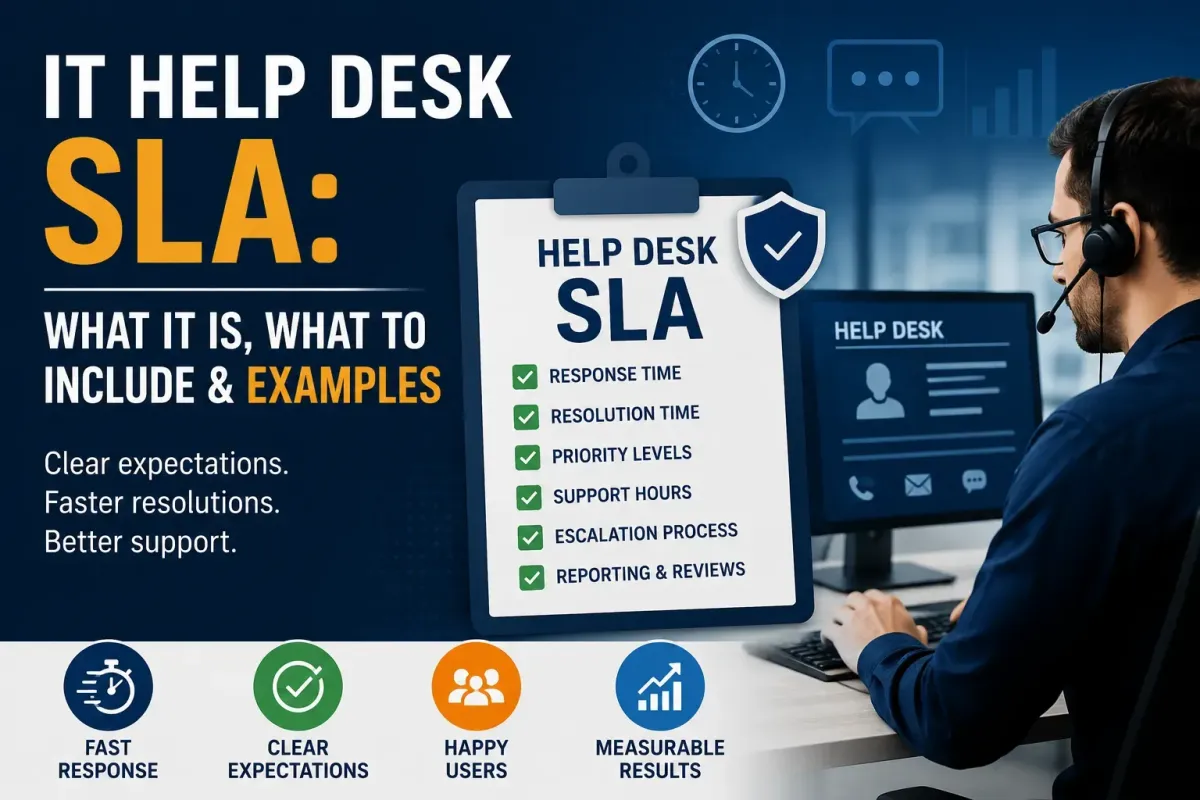
IT Help Desk SLA: What It Is, What to Include & Examples
A clear help desk SLA sets expectations for how quickly IT issues should be acknowledged, handled, and resolved. It provides clear visibility for employees and customers on the IT support they can receive and helps IT teams prioritise requests.
An effective contract will help to communicate, prevent confusion and establish measurable service standards.
The most effective targets need to take into consideration the importance of the problem, the resources that are available, the hours of the business and the level of support being offered.
What is a Help Desk SLA?
A help desk SLA is a contractual agreement that outlines the amount of IT support that a service provider or internal IT department will provide. Usually specifies response time, resolution goals, support hours, priorities, and responsibilities.
Depending on how the IT department functions, a help desk service level agreement could be used for internal staff, external customers, or both.
What Should a Help Desk SLA Include?
A good service desk SLA should make it very clear to users what they can expect from your IT support.
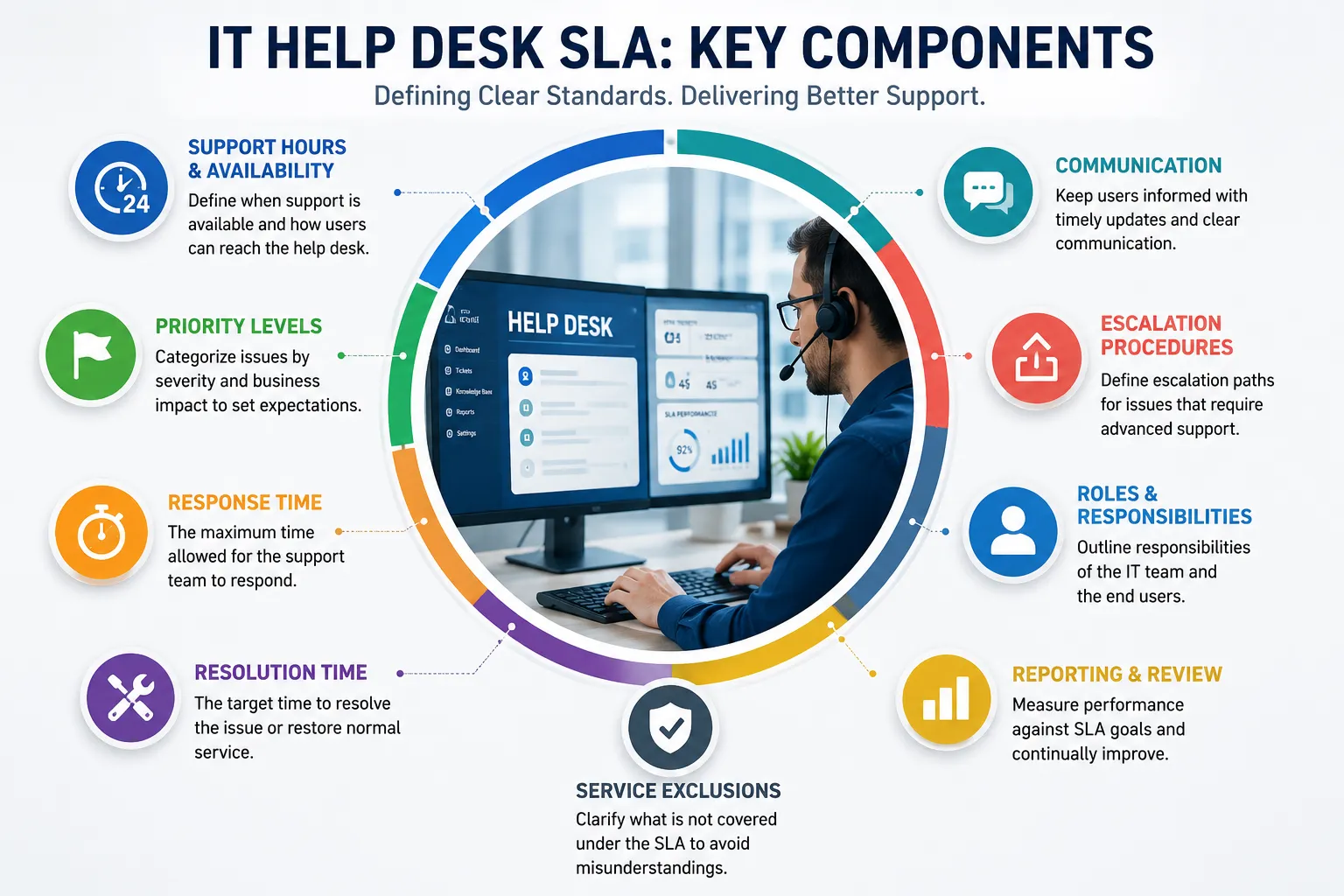
Important elements include:
Support hours and availability
Issue priority levels
SLA response time
SLA resolution time
Communication expectations
Escalation procedures
Customer responsibilities
IT team responsibilities
Service exclusions
Performance reporting
If there are clear definitions, disagreements over whether or not support goals have been achieved are less likely to occur.
How Do IT Support SLA Priority Levels Work?
An IT support SLA usually assigns priorities based on the severity and business impact of an issue.
These are sample targets only. Actual targets should be based on business needs and available support resources.
What is SLA Response Time?
The SLA response time support team responds to or takes action on a reported issue. Does not necessarily imply a problem is solved.
For instance, the initial response to a critical issue might be required within 30 minutes, and resolution put on hold until several hours later.
What is SLA Resolution Time?
SLA resolution time is the timeframe that is agreed upon to troubleshoot and resolve an issue or restore an agreed upon level of service.
The resolution goal should be attainable. There may be technical issues that rely on vendor, hardware replacement, security investigations or other factors that could impact their completion time.
What are Some Help Desk SLA Examples?
Common help desk SLA examples include:
Critical outages are responded to within 15 minutes.
If an issue is considered a priority, it will receive a response within 1 hour.
Standard requests are responded to within 4 business hours.
Low priority requests will be handled within 1 business day.
A continuous update of critical incidents is maintained until service is restored.
These examples may be modified based on the organization's support model.
What are Common IT SLA Examples?
IT SLA examples can cover more than help desk tickets. The agreement could include availability, incident response, maintenance, backups, cybersecurity incidents and technical support goals. The best SLAs will tie tangible goals to business needs and not make empty promises.
How Does an IT Service Level Agreement Improve Support?
A service level agreement for IT support creates measurable expectations between users and the IT team. It can assist groups to concentrate on pressing issues, monitor progress, determine common hold-ups, and enhance duty.
Analyzing the performance of SLA can also provide a roadmap for optimization opportunities related to staffing, processes or technology.
How Can You Create an Effective Help Desk SLA?
The first step is to determine the services that are being provided and what kinds of problems or complaints users frequently encounter. Next, set your priorities and reasonable response and resolution deadlines.
A practical process consists of:
Define supported services.
Define priority buckets.
Set response targets.
Establish resolution targets.
Define support hours.
Document escalation procedures.
Assign responsibilities.
Review performance regularly.
Conclusion
Creating a well-defined help desk SLA is a good way to establish both expectations and understanding about support between the user and the IT team.
Defining priorities, SLA response time, SLA resolution time, responsibilities, and escalation procedures, can help to provide a more consistent support experience.
The optimum agreement must be specific enough to be measured, but flexible enough to accommodate actual business and technical needs.
Frequently Asked Questions
What is a help desk SLA?
A help desk SLA is a contract that outlines the expectation of technical support, such as response time, goal of resolution, hours of support, priorities, and escalation.
What should a help desk service level agreement include?
The essential components of a help desk service level agreement are normally the hours of support, definition of priorities, response and resolution times, who does what, escalation issues, what is not covered, and how support is measured.
What is the difference between response time and resolution time?
SLA response time is the time period that support will acknowledge or begin to work on an issue, and SLA resolution time is the amount of time that has to elapse before support resolves the issue or restores service.
What is an IT support SLA?
An IT support SLA is a contract that sets expectations that are measurable for an IT team and its users/customers. Can specify response time, resolution goals, availability, communication and escalation needs.
What are common help desk SLA examples?
Typical examples are critical incidents within 15 minutes, high priority incidents within one hour and routine requests within several business hours. True targets differ from business to business.
Why are service desk SLAs important?
A service desk SLA can help set expectations, prioritize requests, track support performance and facilitate communication between IT teams and the users they support.
How are IT SLA priorities determined?
Usually the severity of the issue and business impact are used to identify priorities. A general outage will be given a higher priority than a minor problem affecting one user.
What should SLA resolution times include?
Resolution targets should be based on the complexity of the problem, resource limitations, business impact, need for support hours, and third party vendors and/or replacement equipment.
Can an SLA include IT security incidents?
Yes. An SLA can specify response and escalation protocols for cybersecurity breaches, system failures, data issues and other circumstances that demand immediate technical intervention.
How often should an IT service level agreement be reviewed?
An IT service level agreement must be revised regularly and when service, technology, business requirements or support processes evolve. Performance information can inform the feasibility of targets.