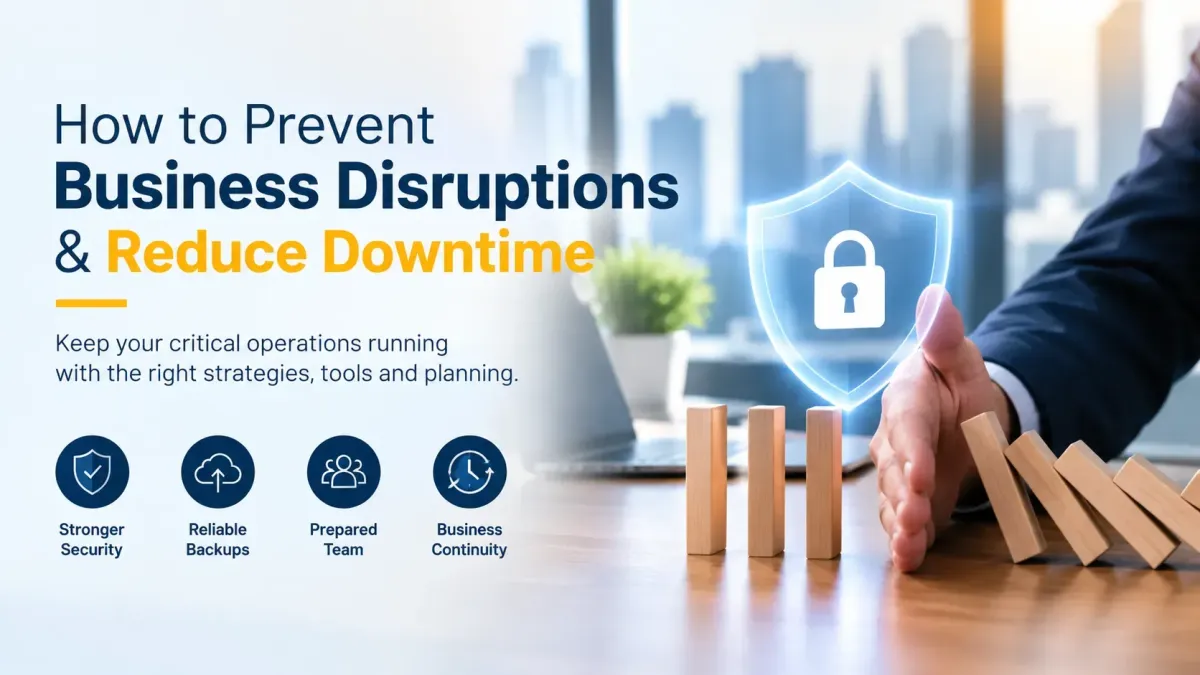
How to Prevent Business Disruptions & Reduce Downtime
Normal operations can come to a halt on a dime if there's a power outage, a cyberattack, some equipment failure, a vendor issue or a natural disaster. Even a few seconds' delay could cause order delays, impact customers, and result in unexpected costs.
When things go wrong, a robust risk management strategy, technology and employee planning and business continuity can help put your company right back on track.
What Causes Business Disruptions?
All companies are exposed to different risks. For a retail business, payment systems and suppliers can be a critical part, whereas for a professional service company, it's the employees, internet and cloud applications.
Some of the common cases of business disruption are:
Cyberattacks and ransomware
Home Internet or electricity outage.
Failure of hardware and software
Natural disasters
Unforeseen delays in delivery or shipment with the supplier.
Building damage
Employee shortages
Data loss
Communication system failures
Awareness of these risks enables prioritisation of systems and processes to be protected.
Create a Disaster Recovery Plan
A disaster recovery plan is a document that outlines the steps your business will take to recover from a major incident if the incident impacts your important systems, data and technology. It should lay out the critical systems, back-up process, recovery duties and the actions that staff are required to take.
Your plan, for instance, might include instructions on restoring files from backups, recovering business applications, replacing damaged equipment or relocating your employees to a different facility.
A DRP does not exist in a folder somewhere. Test it periodically to ensure you are finding any missing information as well as ensuring that employees are aware of what they are responsible for.
Build a Business Continuity Plan
A Business Continuity Plan is a more comprehensive plan than Disaster Recovery. It does not only deal with the technology, it also considers ways in which the whole organisation can continue to deliver valuable products or services during a disruption.
Your plan can include:
Essential business functions
Employee communication
Customer communication
Alternate work locations
Critical suppliers
Emergency contacts
Backup technology
Recovery priorities
Providing employees with a plan of action to follow in the event of a crisis is a component of good business continuity planning, rather than having to make decisions on their own.
Identify Your Business Interruption Risk
It's absurd to be ready for all events. The first step is to figure out your greatest business interruption risk. Afterwards, identify the systems that are crucial and for how long your company can function without them. This will help you to concentrate on your resources where downtime would have the most significant financial or operational impact.
Use Backups to Prevent Business Downtime
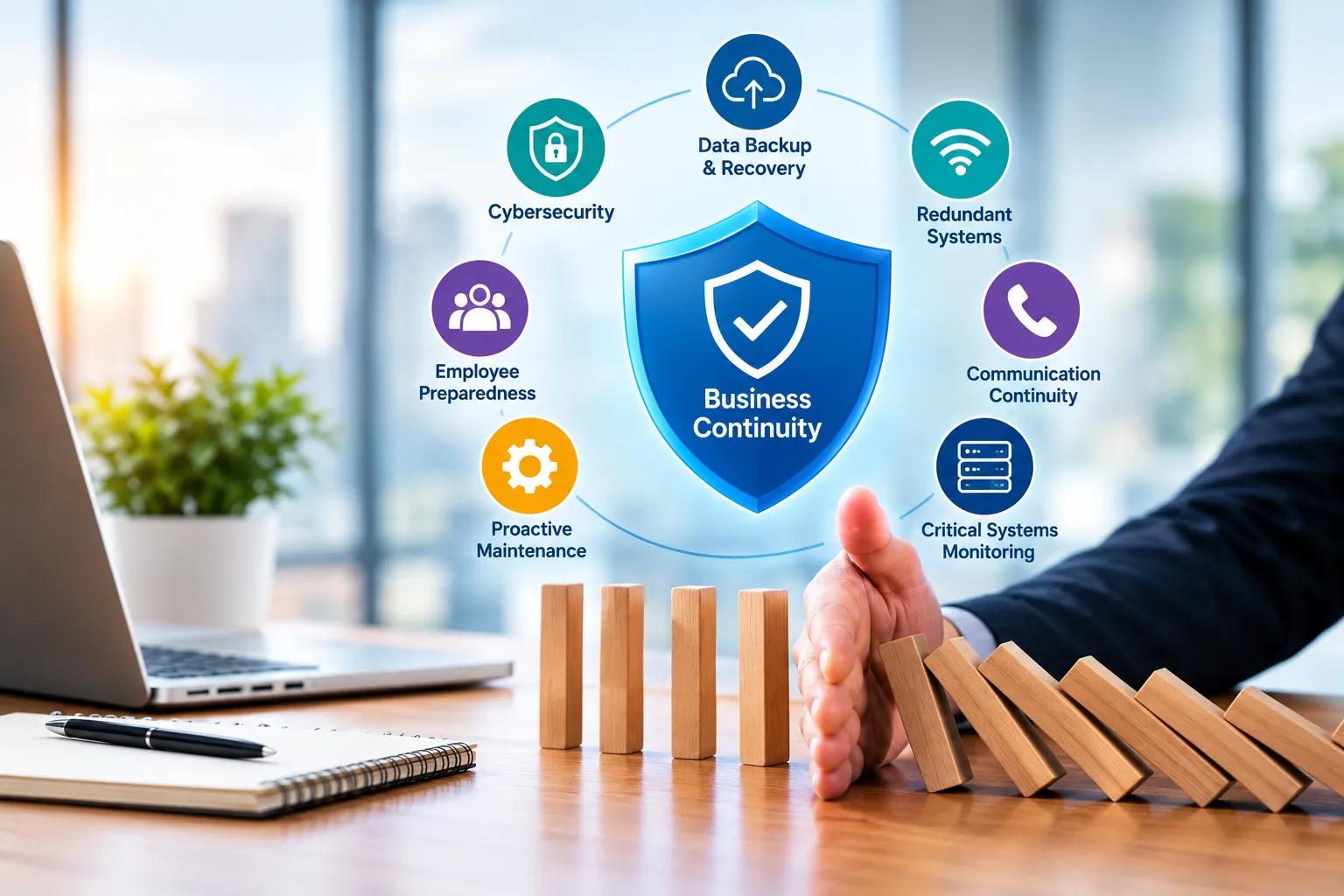
One of the most practical and beneficial solutions to prevent business downtime after data loss or system failure is to have reliable backups.
Backups of important business information should be made on a regular basis, and should be stored in such a way that they are not subject to the same issues as your primary systems. For instance, if the building is damaged only one backup device may not offer much protection in the case that it is in the same office.
Strengthen IT Business Continuity
IT business continuity rely heavily on cloud applications, online sales, digital communication, and remote workers—this is especially critical for businesses in this situation.
Having a reliable infrastructure, updating systems, securing accounts, watching networks and maintaining backups of access to critical applications can help eliminate interruptions caused by technology.
There's also the possibility of having redundant to assist. For instance, if an internet service experiences an outage, having backup internet or communication services will ensure business continuity.
Train Employees Before an Emergency
Technology can't stop all interruptions. Staff should be aware of what to do in case of problems.
Emergency contacts, cyber security procedures, communication methods, backup procedures and individual responsibilities should all be covered in training.
With regular training and practice, there should be less confusion and your team should respond more consistently in case of an emergency.
Prevent Business Interruption With Proactive Maintenance.
Unnecessary business interruption can be caused by waiting for equipment and software failure. Routine upkeep can help discover problems before they turn into significant setbacks. Managed IT services can help businesses take a proactive approach to system maintenance, security updates, monitoring, and technology management.
Ensure that software is kept current, replace old equipment as needed, review and monitor critical systems, review security controls, and regularly review backup systems.
After major changes in technology, staffing, suppliers or operations it is also helpful to review your continuity plan. The business plan that was successful last year might no longer reflect the operations of your business.
Reduce the Cost of Business Downtime
Despite all the best efforts, there's always a possibility of some business downtime. Its aim is to reduce its duration and its impact.
Focus on systems that generate revenue or are necessary for customer service. Set recovery goals for critical applications and identify operations that can be performed manually when necessary. Establishing a clear IT Help Desk SLA can also help define support response expectations when technical problems affect business operations.
It is also important to keep effective communication with employees, customers, suppliers and other stakeholders. If there is any explanation needed as to what's going on and what everyone should expect during recovery, try to do it quickly, otherwise there's a lot of confusion.
Frequently Asked Questions
What is business disruption?
Business disruption is an event which disrupts a business operation and causes a business to be unable to deliver products, services or internal processes as normal.
How can I prevent business interruption?
Understand the key operational risks, secure critical systems, keep backups, educate staff, implement proper redundancy methods and develop and test recovery and continuity plans.
What is the difference between a disaster recovery plan and a business continuity plan?
A disaster recovery plan generally focuses on restoring technology, systems, and data, while a business continuity plan covers the broader steps needed to keep essential business operations running.
What causes business downtime?
Common causes include cyberattacks, equipment failures, power outages, internet problems, natural disasters, software failures, staffing issues, and supplier interruptions.
Why is business continuity important?
Business continuity helps organizations prepare for interruptions so employees know how to maintain critical operations and recover important services more efficiently.
How can backups prevent business downtime?
Reliable and tested backups can help restore important data after accidental deletion, hardware failure, cyberattacks, or other incidents that make primary information unavailable.
What is IT business continuity?
IT business continuity focuses on keeping essential technology, applications, systems, communications, and data available or recoverable during an operational disruption.
How often should a business continuity plan be tested?
Businesses should test their plans regularly and whenever significant operational, technology, staffing, or facility changes occur. Testing can reveal weaknesses before an actual emergency.
What is business interruption risk?
Business interruption risk is the possibility that an event will stop or reduce normal operations and cause financial, operational, or customer-related losses.
Can every business prevent downtime completely?
No. Some interruptions are difficult to predict or avoid entirely. The practical goal is to reduce the likelihood of failures and minimize the time and financial impact when disruptions occur.