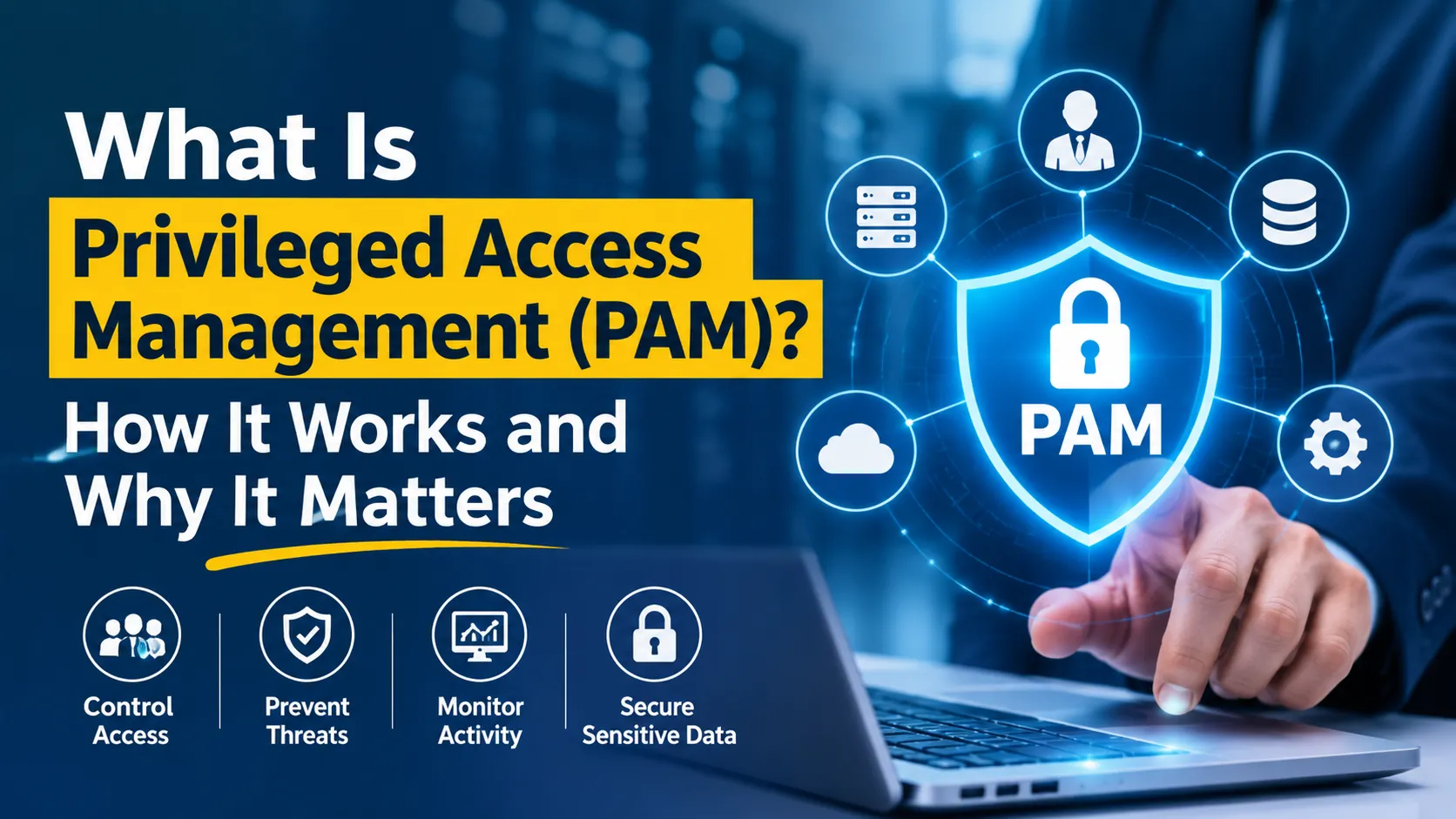
What Is Privileged Access Management (PAM)? How It Works
Employees, service accounts, applications, and IT administrators are all integral to accessing critical systems and sensitive data for businesses. Not all users require the same level of access though. When powerful accounts are not protected, misused, or stolen, they can represent a significant security threat to an entire organization.
Privileged access management (PAM) is used to manage, monitor and secure accounts that have elevated privileges. It restricts access to critical systems and monitors the use of access to critical systems.
By understanding how PAM works, organizations can further mitigate security risks and help safeguard digital assets that are most important to them.
What is Privileged Access Management?
Privileged Access Management (PAM): A cybersecurity strategy that secures the accounts that hold privileged access. These accounts can execute sensitive tasks like changing system settings, handling databases, accessing confidential records and managing networks.
Privileged accounts have more control over business systems, as compared to regular user accounts. Examples include:
IT administrator accounts
Database administrator accounts
The responsibility for managing servers and networks
Cloud infrastructure accounts
Application service accounts
Emergency or shared administrative accounts
PAM's aim is to give privileged access only as needed, for a limited time, and under certain conditions.
What Is PAM in Cyber Security?
PAM, in cybersecurity, is a security practice that aims to thwart unauthorized access to critical systems using strong accounts.
If the administrator account is compromised, attackers have access to sensitive information, can install malicious software, or can move throughout an organization's network.
Controlled access, password authentication, activity tracking and checklists are key features of cybersecurity PAM that help minimize these risks. It also adheres to the principle of least privilege, in that users are given only the permissions necessary to do their jobs.
How Does PAM Work?
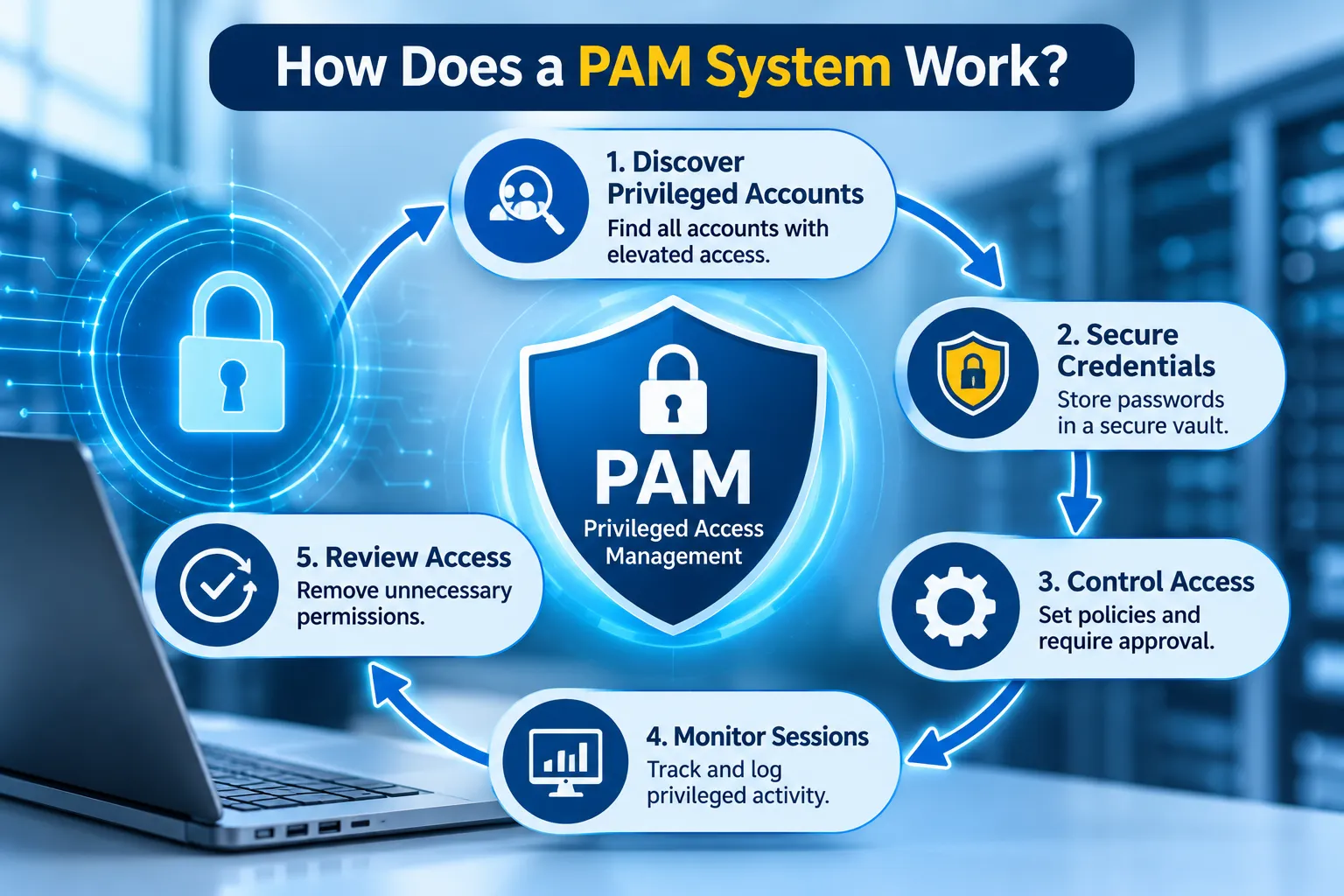
PAM solutions manage privileged accounts through several connected security processes.
1. Discover Privileged Accounts
The first step is identifying accounts with elevated permissions across servers, applications, databases, and cloud environments. Organizations need visibility into both known and overlooked accounts.
2. Secure Credentials
PAM systems can store privileged passwords and other credentials in a secure vault. This reduces the need for employees to know or share sensitive passwords.
Some platforms also rotate passwords automatically to reduce the risk of compromised credentials being reused.
3. Control Access
Administrators can define who may access specific systems and under what conditions. Access may require identity verification, approval, or multi-factor authentication.
4. Monitor Privileged Sessions
PAM tools can record or monitor privileged sessions to help security teams identify unusual behaviour, investigate incidents, and maintain accountability.
5. Review and Remove Unnecessary Permissions
Organizations can regularly review access rights and remove permissions that are no longer required. Temporary access can also expire automatically after a task is completed.
Why Does Privileged Access Management Matter?
Privileged accounts are attractive targets because they provide extensive control over business environments. Without proper protection, one compromised account can create widespread damage.
PAM helps organizations:
Reduce unauthorized access: Limit powerful permissions to approved users.
Protect sensitive information: Secure databases, customer records, and business systems.
Prevent credential misuse: Store and manage privileged passwords securely.
Improve visibility: Track administrative activity across critical systems.
Support compliance: Maintain access records and controls that help meet security and regulatory requirements.
Limit insider threats: Reduce opportunities for employees or contractors to misuse excessive permissions.
Common Privileged Access Management Tools and Solutions
Different organizations need different levels of protection. Privileged access management tools typically provide features such as credential vaulting, session monitoring, access approvals, and password rotation.
Common capabilities include:
Password vaulting: Stores sensitive credentials in a protected location.
Session management: Controls and records privileged connections.
Access management: Defines which users can access specific resources.
Privileged account discovery: Identifies accounts that require additional protection.
Just-in-time access: Grants temporary permissions only when needed.
When evaluating privileged access management software, consider integration with existing identity systems, cloud platforms, reporting features, ease of use, and scalability.
What Is Cloud Privileged Access Management?
Cloud privileged access management extends PAM controls to cloud infrastructure, services, and applications.
Businesses often manage resources across platforms such as public clouds, private clouds, and hybrid environments. These systems create additional privileged accounts, permissions, and service identities that need protection.
Cloud PAM helps organizations control administrative access, manage temporary permissions, monitor activity, and reduce excessive privileges across cloud environments.
It is particularly useful for businesses with remote IT teams, cloud-based applications, and distributed infrastructure.
Conclusion
Privileged access management (PAM) plays an important role in protecting business systems and sensitive information. By securing administrator accounts, controlling permissions, and monitoring privileged activity, organizations can reduce the impact of compromised credentials and unauthorized access.
Frequently Asked Questions
What is PAM?
PAM stands for privileged access management. It is a cybersecurity approach used to secure, control, and monitor accounts with elevated permissions.
What is PAM in cyber security?
PAM in cybersecurity protects powerful accounts from misuse, credential theft, and unauthorized access through access controls, monitoring, and credential management.
Who needs privileged access management?
Businesses with servers, databases, cloud infrastructure, sensitive information, or administrative accounts can benefit from PAM.
Is PAM the same as identity and access management?
No. Identity and access management (IAM) manages access for users across an organization, while PAM focuses specifically on accounts with elevated permissions. PAM is often used alongside IAM.
What are common PAM solutions?
Common PAM solutions include credential vaults, privileged session management, password rotation, temporary access controls, and privileged account discovery.
Does PAM support cloud environments?
Yes. Cloud privileged access management helps secure administrative accounts, service identities, and permissions across cloud infrastructure and applications.
How does PAM reduce security risks?
PAM limits excessive permissions, protects credentials, monitors privileged activity, and helps organizations detect suspicious access.