
System Security Plan (SSP): CMMC Requirements & Examples
If your business handles sensitive information, you need to show how you protect it. That means explaining your systems, security controls, responsibilities, and the steps you take to keep information safe.
That is what a system security plan does. It puts these details in one place and gives your team a clear picture of how security works across the organization.
What is a System Security Plan?
So, what is System Security Plan (SSP) documentation?
Simply put, it explains your information system and how you protect it. It can cover your network, software, hardware, users, system boundaries, security controls, and responsibilities.
The most important thing is accuracy. Your system security plan should describe what you actually have in place, not what you hope to implement later. IT compliance services can also help organizations document and maintain security requirements across their environment.
Why is SSP Documentation Important?
Security details often sit in different policies, spreadsheets, and technical files.
Good ssp documentation brings those details together. Your team can quickly see what is protected, how controls work, and where security gaps may exist.
It can also make compliance reviews easier because the important information is already organized.
What Should a System Security Plan Include?
A system security plan should give readers a clear understanding of your security environment.
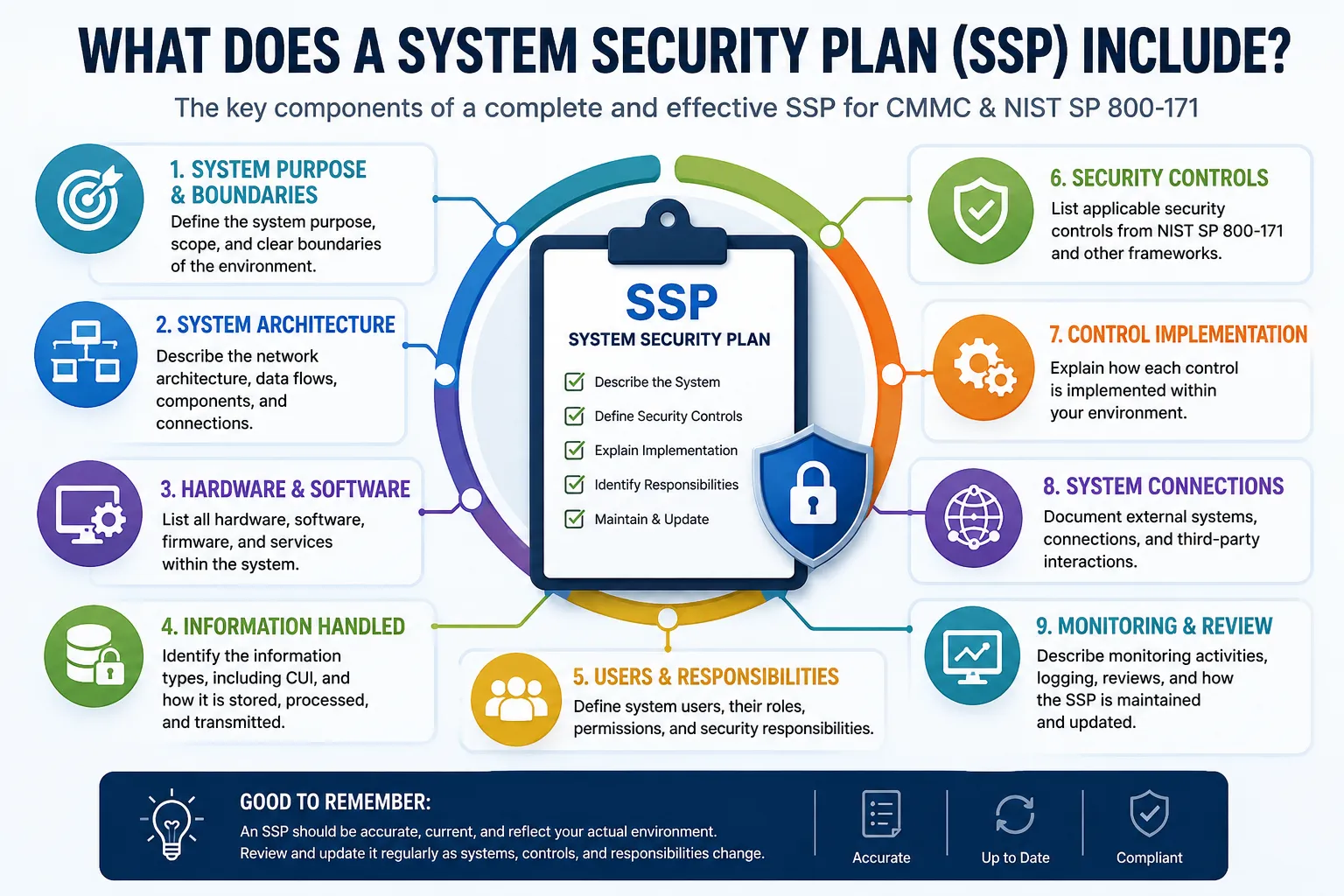
It commonly includes:
System purpose and boundaries
Network architecture
Hardware and software
Information handled
Users and responsibilities
Security controls
Control implementation
System connections
Monitoring procedures
You do not need pages of unnecessary technical language. Just explain what you protect, how you protect it, and who is responsible.
What Does a System Security Plan Example Look Like?
A system security plan example can help you understand the right level of detail.
Instead of saying only that authorized users can access a system, explain how access is approved, how users authenticate, who assigns permissions, and how access is removed.
That gives a much clearer picture of how the control actually works.
What is an SSP Document?
An ssp document is simply the file containing your System Security Plan.
It can be a Word document, PDF, or another format that works for your organization.
The format matters less than the information inside it. Keep the document accurate and update it when your systems or security processes change.
How Does an SSP Help With CMMC?
For organizations working with defense contracts or Controlled Unclassified Information, CMMC can make security documentation especially important.
A cmmc system security plan explains how applicable security practices are implemented in your environment.
Your documentation should match reality. If the SSP says a control is implemented, your systems and procedures should support that claim. An accurate SSP can also make CMMC assessment preparation more organized by clearly documenting how your security requirements are implemented.
What is a CMMC SSP?
A CMMC SSP documents the systems in scope and explains how applicable security requirements are implemented within your environment. The goal is not simply to create a document for an assessment. It should accurately describe how your security program works.
Can You Use a CMMC SSP Template?
Yes. A cmmc ssp template can give you a useful starting point. It can help organize information about your systems, users, controls, responsibilities, and boundaries. But do not copy a template and consider the work finished. You still need to customize it around your actual environment.
Is a System Security Plan Template Useful?
A system security plan template can save time, especially if you are creating an SSP for the first time. Use it as a guide, then fill in your own information and remove anything that does not apply. A template provides the structure. Your organization provides the details.
How Does an SSP Work With a POA&M?
The SSP and POA&M have different purposes. The SSP explains your current security controls and how they are implemented. A POA&M tracks security gaps and the actions needed to fix them.
That is why ssp & poam are often used together. If security requirements are not fully implemented, the SSP should accurately describe the current implementation status, while a POA&M, when permitted, can document eligible gaps and planned corrective actions.
When Should You Update Your SSP?
Do not create your system security plan and forget about it. Your systems will change. You may add software, replace hardware, change users, or update security controls.
When those changes affect your SSP, update it. Regular reviews can also help you find outdated information before an assessment.
What Makes a Good SSP?
A good system security plan should be clear, specific, and easy to follow.
It should answer:
What system are you protecting?
What information does it handle?
Who has access?
What controls are in place?
How do those controls work?
Who is responsible?
What still needs attention?
Keep it simple. The document should explain your security environment, not make it harder to understand.
What SSP Mistakes Should You Avoid?
A few mistakes can make an SSP less useful.
Watch for:
Generic information that does not match your environment
Vague control descriptions
Unclear system boundaries
Missing responsibilities
Outdated system information
Claiming planned controls are already implemented
Failing to update the SSP after system changes
Your SSP does not have to be huge. It needs to be accurate, current, and easy to understand.
Frequently Asked Questions
What is a system security plan?
A system security plan explains an information system, the information it handles, its security controls, and how those controls are implemented.
Why is SSP documentation important?
It gives your organization one clear place to document its security environment and can support compliance preparation and security reviews.
What should an SSP include?
It generally covers system boundaries, architecture, users, information, technology, responsibilities, security controls, and implementation details.
Is an SSP required for CMMC?
Requirements depend on the applicable CMMC level, scope, and contract requirements. Organizations should review the current requirements that apply to them.
Can I use an SSP template?
Yes. A template can provide structure and save time, but it must be customized to your actual systems and security practices.
What is the difference between an SSP and POA&M?
The SSP describes your current security environment. A POA&M tracks security gaps and the actions planned to address them.
How often should an SSP be updated?
Review it regularly and update it whenever important changes affect your systems, controls, responsibilities, or scope.
Can an SSP help with a CMMC assessment?
Yes. An accurate SSP can help explain the environment being assessed and how applicable security practices are implemented.
What makes an SSP effective?
It should be clear, accurate, current, specific, and consistent with your actual security environment.
Does every organization need the same SSP format?
No. A template can provide structure, but the final SSP should reflect your organization's own systems, people, information, and security requirements.